PRACTICE · ETHICS · GOVERNANCE
NOV 16, 2026
BY CLARA KLEIN
Will AI replace customer service jobs?
Not wholesale. 21% of service leaders say they cut agents because of AI, and entry-level hiring is where it shows. What's changing, and what stays with people.
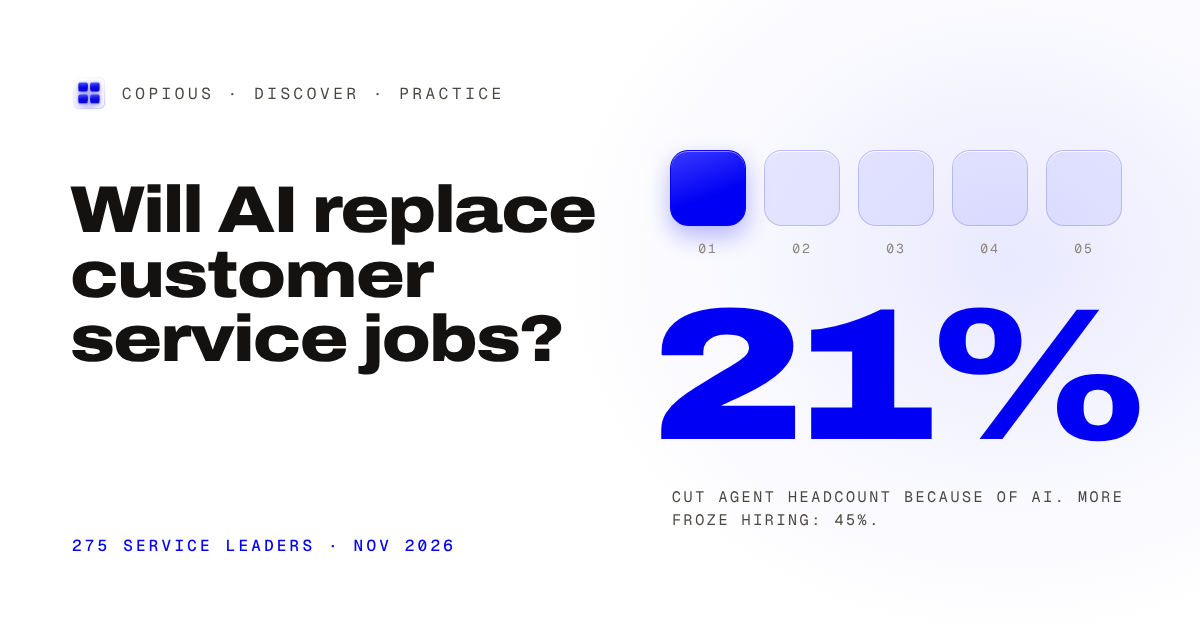
Not wholesale, and not yet. AI is taking over some customer service tasks, and the effect shows first in fewer entry-level hires, not mass layoffs. In a Gartner survey of 275 service and support leaders in July and August 2026, 21% said their organizations had cut human agent headcount because of AI (published Nov 5, 2026). Far more froze hiring or moved agents into other work. Which work stays with people is a decision you make, one ticket type at a time.
TL;DR
- Cuts are real but not the norm: 21% of leaders reported AI-driven headcount reductions, averaging 16.7% of the workforce over 18 months.
- The quieter change is hiring: 45% of leaders report a hiring freeze. Early-career workers in AI-exposed jobs, customer service included, saw a 13% relative drop in employment.
- The Bureau of Labor Statistics projects customer service representative jobs to fall 5% from 2024 to 2034, with about 341,700 openings a year still.
- Cutting before the AI works is the expensive path. Gartner predicts half of companies that cut service staff because of AI will rehire by 2027.
Is AI replacing customer service jobs right now?
For a minority of teams, yes. For most, it's changing the job before it changes the headcount.
Gartner's latest numbers, from its survey of 275 service and support leaders in July and August 2026, published Nov 5, 2026:
- 21% said their organizations had reduced human agent headcount because of AI.
- Among those, the average reduction was 16.7% of the workforce over the previous 18 months.
- 45% reported a hiring freeze, and 39% were moving agents into other business units.
- 20% were using forced reductions as a workforce strategy.
- 71% were moving agents into different roles inside service and support.
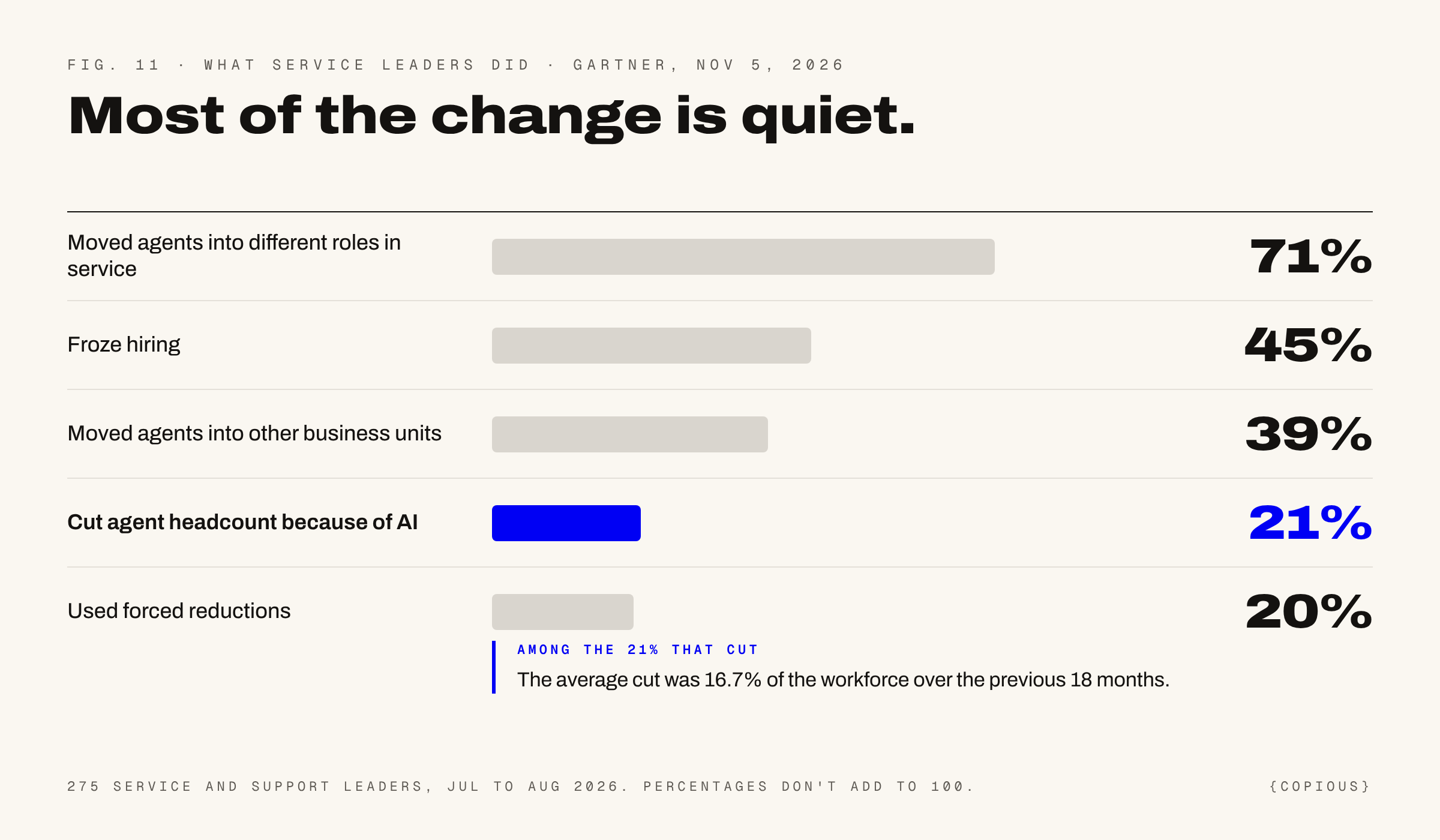
Fig. 11. Hiring freezes and moves outnumber AI-driven cuts. Gartner, Nov 5, 2026.
A year earlier, Gartner's October 2025 survey of 321 leaders put the share that had cut staff because of AI at 20%. In twelve months, the number moved one point.
Plans run ahead of results. In April 2026, Gartner reported that 31% of service and support leaders had implemented, or were planning, AI-driven frontline layoffs through the first quarter of 2027.
Which customer service jobs are most at risk?
Entry-level ones.
Stanford economists Erik Brynjolfsson, Bharat Chandar and Ruyu Chen studied payroll data from ADP. In the most AI-exposed occupations, which include customer service representatives, workers aged 22 to 25 saw a 13% relative decline in employment since generative AI spread, after controlling for firm-level shocks. Older workers in the same fields kept gaining jobs. The paper, "Canaries in the Coal Mine?", was first released Aug 26, 2025 and revised Nov 13, 2025. The authors call it early evidence, not a final answer.
The government's forecast points the same way, more slowly. The Bureau of Labor Statistics counted about 2.8 million customer service representative jobs in 2024 and projects a 5% decline by 2034, about 153,700 fewer jobs. It still expects about 341,700 openings a year, mostly from people leaving the job.
Our read: the tasks that go first are routine ones with written rules, like order status and password resets. Those are the same tasks new agents learn on. If AI takes all of them, you need a new answer to where your next tier 2 agent learns the job.
What does AI do to the agents who stay?
It makes newer agents faster, and it adds work to their jobs.
In "Generative AI at Work," Brynjolfsson, Danielle Li and Lindsey Raymond studied 5,179 customer support agents as an AI assistant rolled out. Issues resolved per hour rose 14% on average, and 34% for novice and lower-skilled agents, with little effect on the most experienced (NBER working paper 31161, 2023). Customer sentiment improved and agents were more likely to stay. A later peer-reviewed version revised some estimates but kept the pattern: the biggest gains went to the least experienced.
Leaders are also widening the job. In a Gartner survey of 321 leaders in September and October 2025, 85% said they were adding new tasks and responsibilities to frontline agent roles (published Apr 28, 2026).
Why are some companies rehiring after AI cuts?
Because they cut on expected results, not proven ones.
On Feb 2, 2026, Gartner predicted that by 2027, half of companies that cut customer service staff because of AI will rehire people to do similar work, often under different job titles. An earlier Gartner prediction, from Jun 10, 2025, said half of organizations that expected to significantly reduce their service workforce would abandon those plans by 2027. In that poll of 163 leaders, 95% said they planned to keep human agents.
Customers are part of the reason. In a Gartner survey of 3,566 customers in early 2026, 87% said an option to reach a person is essential when a company uses generative AI for service (published Aug 4, 2026). A team with no people to reach can't meet that. (What customers say about AI service.)
How do you decide which work stays with people?
Not with a headcount target. With a decision for each ticket type, a kind of request your queue handles. There are four calls, and the last two are wins, not failures:
- Hand it to AI when the ticket type is high-volume and its rules are written down.
- Automate it a simpler way when a macro or a form does the job.
- Fix the process first when the ticket type is slow because of handoffs, not effort.
- Keep it with your people when the work needs judgment the rules don't cover, or someone has to answer for the outcome.
On one real queue, anonymized, escalation to tier 2 ran 40 tickets a month and missed its SLA target 61% of the time. The call was to fix the process first. AI would have made a broken handoff faster, not better.
- List ticket types by volume. Biggest first.
- Ask three questions of each. Are the rules written down? Is money, an exception or a promise involved? Who answers if the answer is wrong?
- Make one call per ticket type, with one sentence on why.
- Put a person on sign-off where money moves. Refunds, credits and exceptions are the usual start.
- Decide where new agents learn. If AI takes the simple tickets, write down how a new hire gets their reps.
- Plan headcount last. Change staffing after a ruling has held up for a quarter, not before.
Pass: for every ticket type AI handles, you can name the rule it follows and the person who answers for it. For every ticket type your people keep, you can say why in one sentence.
Where Copious fits
Copious helps you make that call one ticket type at a time. The owner describes the work, and Copious suggests one of the four calls and shows the words that decided it. "Keep it with your people" carries the same weight as "hand it to AI." The owner makes the call, and each ruling is filed with its date, its owner and the rules it was checked against, so you can show leadership why a ticket type stayed with people. Any ruling can be forwarded as a link, no login needed. See pricing.
Copious doesn't plan headcount, and it doesn't answer tickets.
Where this doesn't apply
- We don't forecast jobs. The surveys here report what leaders say they did or plan to do. The BLS numbers are projections, not AI-impact forecasts.
- Some Gartner samples are worldwide, not US-only. The BLS and Stanford figures are US.
- The Stanford paper shows a pattern consistent with AI's effect. Its authors say other causes can't be ruled out yet.
- Outsourced and offshore support may move faster or slower than in-house teams. These sources don't break that out.
- Phone and chat differ. Most of the evidence above mixes channels.
Frequently asked questions
Will AI replace call center agents?
Not wholesale so far. In Gartner's July and August 2026 survey of 275 service leaders, 21% had cut agent headcount because of AI, and the average cut among them was 16.7% over 18 months. Hiring freezes, at 45%, were more common than cuts. Expect fewer entry-level hires before fewer agents overall.
Which customer service jobs can't be replaced by AI?
The ones built on judgment and accountability: disputes, exceptions, refunds outside policy, upset or vulnerable customers, and anything where someone has to answer for the outcome. Routine ticket types with written rules, like order status, are the first to move. Decide ticket type by ticket type rather than by job title.
Is customer service still a good career with AI?
It's changing. The BLS projects a 5% decline in customer service representative jobs from 2024 to 2034, with about 341,700 openings a year. Gartner found 85% of service leaders adding new responsibilities to agent roles. The work that grows is the work AI can't do alone: judgment calls, escalations and overseeing AI's answers.
Are companies rehiring customer service agents after AI layoffs?
Some are. Gartner predicted on Feb 2, 2026 that half of companies that cut service staff because of AI will rehire for similar work by 2027, often under new titles. The usual cause is cutting on expected AI results before the AI proved it could handle the work.
How many customer service jobs will AI eliminate?
Nobody knows yet, and we don't forecast it. The BLS projects about 153,700 fewer customer service representative jobs between 2024 and 2034, a 5% decline, but that projection isn't an AI-specific estimate. Surveys show most teams shrinking through hiring freezes and attrition rather than layoffs.
Related: What should AI handle in customer support? · What is the 30% rule for AI? · Do customers like AI customer service?
Sources
Checked Nov 16, 2026.
- Gartner survey finds 21% of service and support leaders have reduced human agent headcount because of AI · Gartner, Nov 5, 2026
- Gartner survey finds 31% of service and support leaders have implemented, or are planning, AI-driven frontline layoffs through 1Q27 · Gartner, Apr 27, 2026
- Gartner survey finds 85% of service and support leaders are expanding human agent responsibilities · Gartner, Apr 28, 2026
- Gartner predicts half of companies that cut customer service staff due to AI will rehire by 2027 · Gartner, Feb 2, 2026
- Gartner survey finds only 20% of customer service leaders report AI-driven headcount reduction · Gartner, Dec 2, 2025
- Gartner predicts 50% of organizations will abandon plans to reduce customer service workforce due to AI · Gartner, Jun 10, 2025
- Gartner survey finds 87% of customers say companies using GenAI for customer service must provide access to a human agent · Gartner, Aug 4, 2026
- Canaries in the Coal Mine? Six facts about the recent employment effects of artificial intelligence · Brynjolfsson, Chandar and Chen, Stanford Digital Economy Lab, Nov 13, 2025
- Generative AI at Work · Brynjolfsson, Li and Raymond, NBER Working Paper 31161, 2023
- Customer service representatives, Occupational Outlook Handbook · US Bureau of Labor Statistics
Copious helps support and CX leaders decide what AI should handle in their queue and what their people should keep, one ticket type at a time. We take no money from AI vendors.