PRACTICE · GOVERNANCE
NOV 16, 2026
UPDATED NOV 17, 2026
BY CLARA KLEIN
What is the 30% rule for AI?
The 30% rule for AI is a rule of thumb, not a standard: AI does about 70% of the work and people keep 30%. In a support queue, decide by ticket type instead.
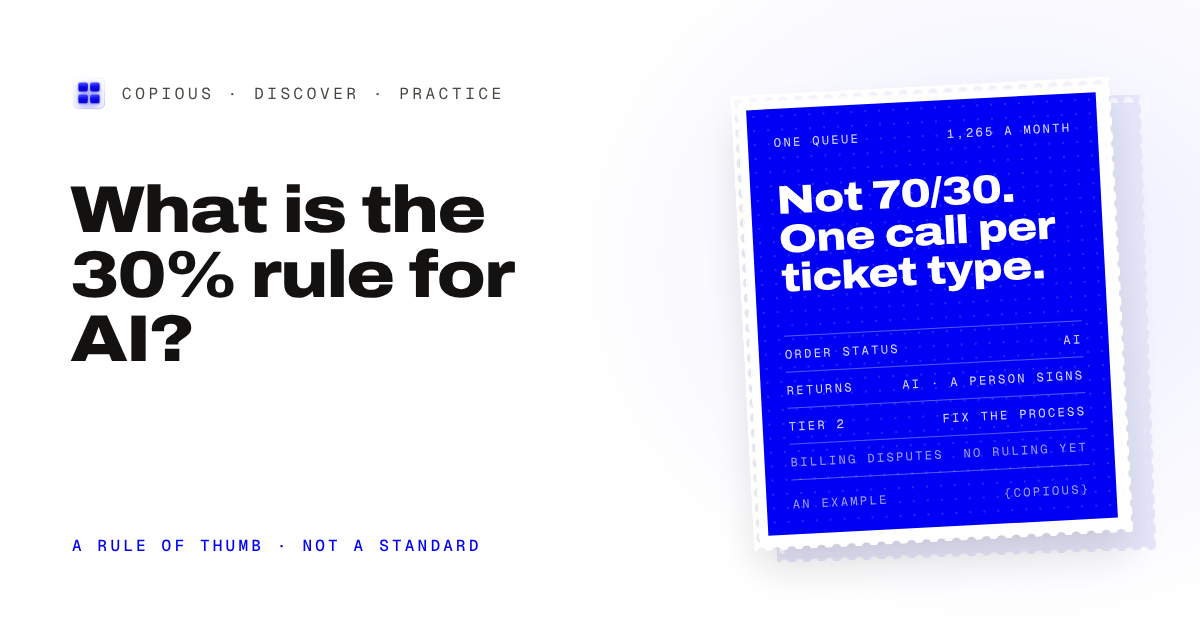
The 30% rule for AI is a rule of thumb, not a law or a standard. At work, it usually means AI handles about 70% of routine tasks and people keep the 30% that needs judgment. In schools, it usually means no more than 30% of a paper should be AI-written. We couldn't find where it started: no regulator, standards body or research paper we checked defines it. For a support queue, a flat percentage is the wrong unit. Decide one ticket type at a time, and the share AI handles falls out of those decisions.
TL;DR
- The 30% rule is a heuristic with two meanings: a 70/30 split of work, and a cap on AI-written schoolwork. No official source sets either number.
- In support, the right share depends on the ticket type. In a 2023 Gartner survey, chatbots resolved 58% of returns and cancellations but 17% of billing disputes.
- A quota pushes the wrong work to AI. Only 27% of customers would try a chatbot again after a bad experience (Gartner, Sep 2, 2026).
- Rule each ticket type, then count. Pass: you can say which ticket types are in your "AI" column and why, without quoting a percentage.
Where does the 30% rule for AI come from?
Nowhere official. It spread through blog posts, syllabi and social feeds, and it means two different things depending on who's asking.
At work, it's a 70/30 split. AI takes roughly 70% of repetitive, data-heavy tasks. People keep the 30% that needs judgment, creativity and oversight. It's a way of saying "don't automate the whole job," with numbers attached.
In school, it's a ceiling. Students hear that a paper should score under 30% AI-written. That isn't a detector's rule either. When Turnitin updated its AI writing indicator in May 2023, it added an asterisk to scores under 20%, because it had found more false positives below that level. That's a warning about reliability, not an allowance.
A related number turns up in the same searches. Boston Consulting Group's 10-20-70 rule says the effort in an AI program should go 10% to algorithms, 20% to technology and data, and 70% to people and processes. It's about where to spend effort, not which work AI should do.
Is 30% the right share of AI work for a support team?
No single share is right, because the answer changes with the ticket type. A ticket type is a kind of request your queue handles, like order status lookups or billing disputes.
Gartner's June 15, 2023 survey of 497 B2B and B2C customers shows how wide the gap is. Customers who used a chatbot resolved 58% of returns and cancellations, and 17% of billing disputes. Same channel, different work, more than three times the resolution rate. A queue that's mostly returns and a queue that's mostly billing disputes shouldn't be aiming at the same number.
A target also changes behavior. If the goal is "AI handles 70%," someone will push a ticket type into the bot to hit it, and customers pay for the miss. In a Gartner survey of 3,566 customers in February and March 2026, 87% said an option to reach a person is essential when a company uses generative AI for service (published Aug 4, 2026). In the same survey, only 27% said they'd try a chatbot again after a negative experience (published Sep 2, 2026). One bad quota can close a channel.
What should you use instead of a percentage?
A decision for each ticket type. We use four calls, and they carry equal weight:
- Hand it to AI. The ticket type is high-volume and its rules are written down.
- Automate it a simpler way. A macro, a form or a status page does the job without a model.
- Fix the process first. The ticket type is slow because of handoffs or missing rules, and AI would speed up a broken process.
- Keep it with your people. The work needs judgment the rules don't cover yet, or someone has to answer for the outcome.
Here's how that plays out on one real queue, anonymized:
- Order status lookup, 310 tickets a month: hand it to AI.
- Return and exchange requests, 265: hand it to AI, with a person signing off.
- Refund eligibility, 240: no ruling.
- Shipping exceptions, 195: no ruling.
- Billing disputes, 120: no ruling.
- Product troubleshooting, 95: no ruling.
- Escalation to tier 2, 40: fix the process first.
Across these seven ticket types, 1,265 tickets a month. AI handles 310 on its own, about a quarter. Add the 265 that AI handles with a person signing off, and AI touches 575, a little under half. Nobody set either number. They came from the rulings.
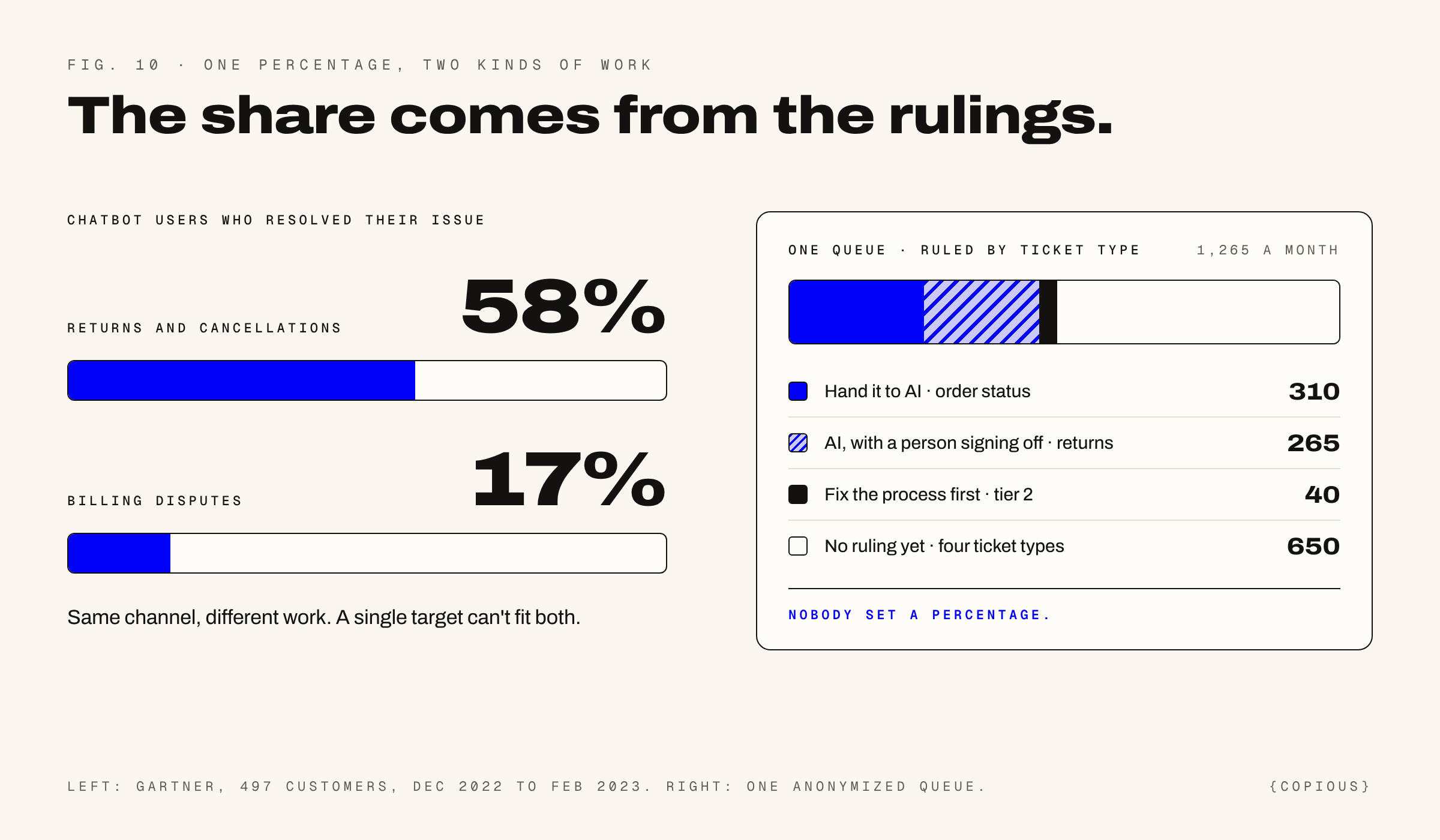
Fig. 10. The same channel resolves one kind of work more than three times as often as another, so the share AI handles comes from ruling each ticket type.
The number that matters is the third one: four ticket types and 650 tickets a month with no decision at all. Escalation to tier 2 missed its SLA target 61% of the time, and the call there was to fix the process, not to hand it to a model. (Why handoffs predict SLA misses.)
How do you work out your own split?
- List your ticket types by volume. Use your helpdesk's ticket form, type or tag field. Biggest first.
- Write the rules for the top five. In plain sentences: what the answer depends on, and who decides.
- Make one call per ticket type. Use the four calls above. Write one sentence on why.
- Mark where a person signs off. Refunds, credits, exceptions and account changes are the usual start.
- Count. Tickets AI handles alone, tickets AI drafts and a person decides, tickets people keep, and tickets with no ruling.
- Re-check when something changes. A new model, a new policy or a jump in reopens means the ruling needs re-verifying.
Pass: for every ticket type in your AI column, you can name the rule it follows and who answers for a wrong answer. If your answer to "how much does AI handle?" is "about 70%," it fails.
Where Copious fits
Copious lists every ticket type in your queue by volume, from your helpdesk's structure, not its conversations. That list is the Ledger, and a ticket type with no decision shows as a blank row. For each one, the owner describes the work and Copious suggests one of the four calls, showing the words that decided it. The owner makes the call, and the ruling is filed with its date, its owner and the rules it was checked against. The share AI handles is something you read off the Ledger, not a target you set. See pricing.
Copious doesn't answer tickets.
Step by step in the Copious docs: Your first ruling in ten minutes · Read the Ledger
Where this doesn't apply
- If your employer or school has written a 30% limit into its own policy, that's the rule you follow. We're describing the informal heuristic, not anyone's policy.
- The Gartner resolution rates come from a 2023 survey of chatbot users, before most of today's models. Read them as proof that ticket types differ, not as today's rates.
- The queue above is one queue. Your volumes and rulings will be different.
- A percentage is fine as a report-out. Once the rulings exist, "AI handles 24% of volume" is a useful line for leadership. It's the wrong tool for making the rulings.
Frequently asked questions
Is 30% AI acceptable?
It depends on who set the limit. Some schools and employers write their own percentage into policy, and theirs is the one that counts. No law or standard sets 30%. For AI detectors, Turnitin said in May 2023 that its scores under 20% are less reliable, so a score is a reason to ask questions, not proof.
What is the 70/30 rule for AI?
It's the workplace version of the 30% rule: AI handles about 70% of routine, repetitive tasks, and people keep about 30% for judgment, creativity and oversight. It's a rule of thumb with no official source. In customer support, the right split depends on which ticket types your queue handles, so it's better worked out than assumed.
What is the 10-20-70 rule for AI?
It's a Boston Consulting Group guideline for AI programs: put 10% of the effort into algorithms, 20% into technology and data, and 70% into people and processes. It's about where effort goes, not how much work AI should do. For support teams, much of that 70% is writing down the rules AI will follow.
What percentage of customer service should be handled by AI?
There's no correct percentage. It depends on your ticket types: in a 2023 Gartner survey, chatbots resolved 58% of returns and cancellations but 17% of billing disputes. Rule each ticket type first, deciding whether AI handles it, a simpler automation does, the process needs fixing, or people keep it. Then count.
Does the 30% rule mean AI will take 70% of jobs?
No. It describes splitting tasks inside a job, not cutting jobs. In a Gartner survey of 275 service and support leaders in July and August 2026, 21% said their organizations had reduced agent headcount because of AI. Most of the change is in which tasks agents do. More on AI and customer service jobs.
Related: What should AI handle in customer support? · Do customers like AI customer service? · Will AI replace customer service jobs?
Sources
Checked Nov 16, 2026.
- Gartner survey reveals only 8% of customers used a chatbot during their most recent customer service interaction · Gartner, Jun 15, 2023
- Gartner survey finds 87% of customers say companies using GenAI for customer service must provide access to a human agent · Gartner, Aug 4, 2026
- Gartner survey finds only 27% of customers would try a chatbot again after a negative experience · Gartner, Sep 2, 2026
- Gartner survey finds 21% of service and support leaders have reduced human agent headcount because of AI · Gartner, Nov 5, 2026
- AI writing detection update from Turnitin's chief product officer · Turnitin, May 2023
- The formula for agentic AI value · Boston Consulting Group, 2026
Copious helps support and CX leaders decide what AI should handle in their queue and what their people should keep, one ticket type at a time. We take no money from AI vendors.