REGULATION · GOVERNANCE · PRACTICE
NOV 01, 2026
BY COPIOUS
Do you have to tell customers they're talking to AI?
California, New Jersey, Maine, Utah and the EU already require AI disclosure in some cases. California adds a right to a person in 2027. What each rule asks.
Sometimes, and more often from Jan 1, 2027. No single US law makes every support bot say it's AI. But California, New Jersey, Maine and Utah already require disclosure in some situations. California adds a right to reach a person at large businesses from Jan 1, 2027. New York City has proposed the most detailed rule yet, and the EU has required disclosure since Aug 2, 2026. The safe default for any support bot: say it's AI in the first message, and offer a person in one step.
TL;DR
- In force now: California (bots that pose as human to sell), New Jersey (bots that sell or advertise), Maine, Utah (when a customer asks) and the EU.
- From Jan 1, 2027: California's AB 1609, for businesses with more than $500 million in gross annual revenue: disclose, and connect customers to a person.
- Proposed: New York City's rule for automated customer service, with a one-step route to a person and three years of records.
- The default that meets most of them: disclose in the first message, offer a person in one step, and log every handoff.
This is a summary of the law as of Nov 1, 2026, not legal advice. Ask your counsel which rules reach you.
What counts as an AI disclosure?
An AI disclosure is a clear statement, at the start of a conversation, that the customer is dealing with an automated system and not a person. Most of the rules below ask for it in the same channel the bot uses: on screen in chat, spoken on a call.
A "talk to a person" rule is a requirement that customers can ask for a human and actually reach one. As of Nov 1, 2026, California is the only state we found that has enacted one for customer service.
Which laws require a support bot to say it's AI?
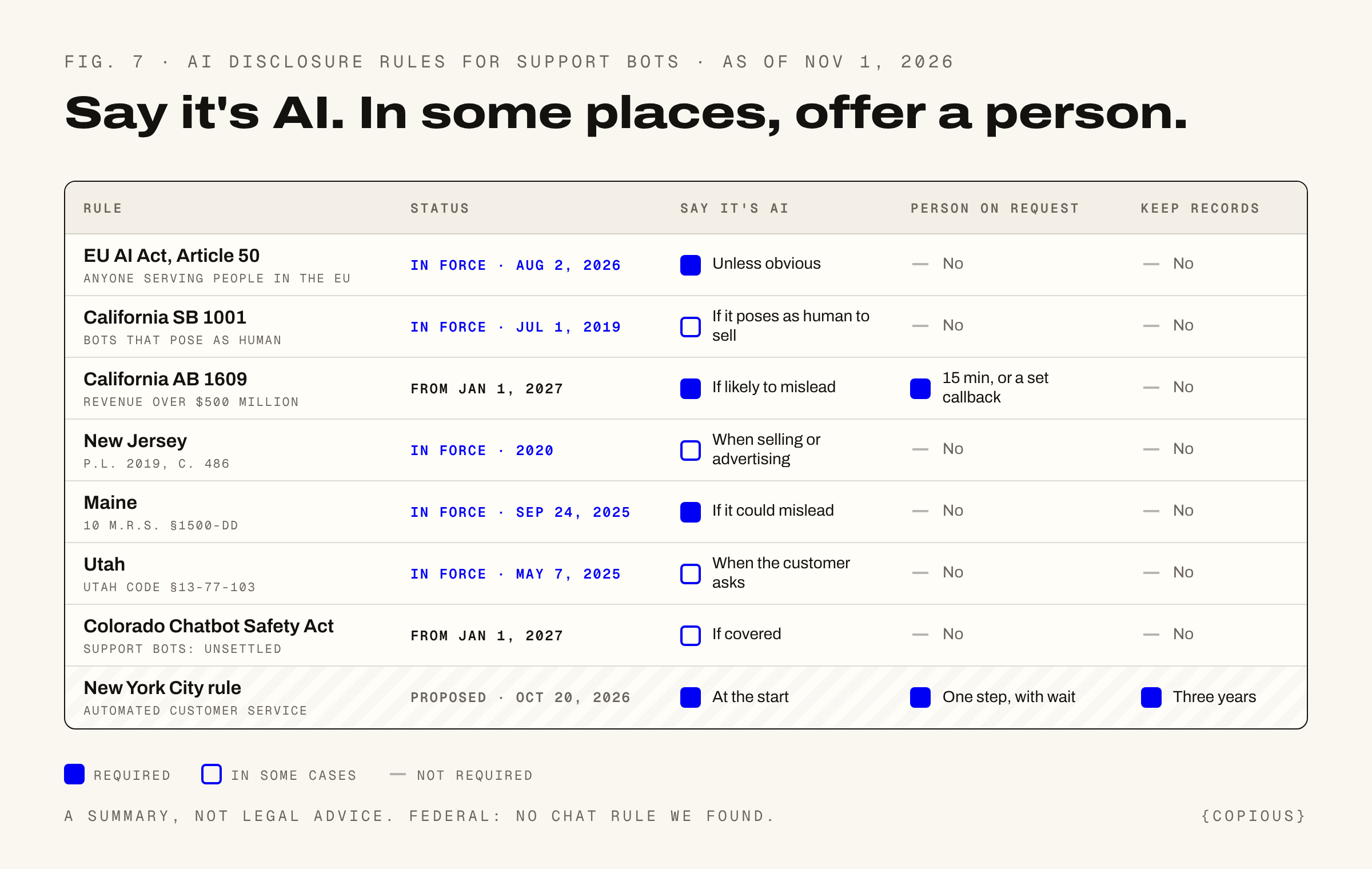
Fig. 7. What each rule asks of a support bot, as of Nov 1, 2026. A summary, not legal advice.
California: a bot law since 2019, and a human-service law from 2027
SB 1001, in force since Jul 1, 2019. It's unlawful to use a bot to talk to someone in California online with the intent to mislead them about its artificial identity, in order to drive a sale or influence a vote. A clear, conspicuous disclosure avoids liability (California Business and Professions Code §§17940 to 17943). A support bot is only at risk if it poses as human to sell.
AB 1609, which its author calls the Right to Human Customer Service Act. Signed Sep 28, 2026, it takes effect Jan 1, 2027, under California's default start date for new laws. It covers businesses with more than $500 million in gross annual revenue nationally that serve California customers (bill text, Senate Judiciary analysis). Under it:
- A customer service chatbot can't be presented as human. Where a reasonable person is likely to be misled, it must say it's AI, in the same medium it uses.
- During business hours, every customer service channel needs a clear, simple way to ask for a person.
- The business must make a good-faith effort to connect the customer within 15 minutes, or schedule a call within one business day.
- Once a customer reaches a person, the business must make a good-faith effort to keep holds under 15 minutes at a time and 1 hour in total.
- The 15-minute rule doesn't apply to email, web forms or voicemail.
- Public prosecutors enforce it, with penalties up to $5,000 for a first violation and $10,000 for each one after. There's no private right of action.
Some services are exempt, including hospital communications about health care and consumer reporting agencies. (The Desk 02 covered the signing.)
California's companion chatbot law, SB 243, expressly excludes bots used only for customer service.
New Jersey: disclose at the outset when selling
A New Jersey law approved Jan 21, 2020 (P.L. 2019, c. 486) and in force since that summer bars using an online bot with people in New Jersey in connection with selling or advertising merchandise or real estate unless the bot is disclosed at the outset (New Jersey Legislature). Unlike California's law, it doesn't require an intent to mislead. Penalties run from $2,500 to $10,000. A support bot that recommends or sells products is the case to check.
Maine: disclose whenever a customer could be misled
Since Sep 24, 2025, Maine has barred using an AI chatbot in trade or commerce in a way that may mislead a reasonable consumer into thinking they're dealing with a person, unless the consumer gets clear and conspicuous notice (10 M.R.S. §1500-DD, from LD 1727). A violation counts under Maine's Unfair Trade Practices Act.
Utah: disclose when the customer asks
Since May 7, 2025, a business using generative AI in a consumer transaction must disclose it when the person clearly asks. People in regulated occupations must disclose it up front in high-risk interactions, such as giving financial or medical advice (Utah Code §13-77-103). A business that discloses at the outset and throughout gets a safe harbor (§13-77-104). Fines run up to $2,500 per violation.
New York City: the most detailed rule so far, still a proposal
On Oct 20, 2026, New York City's Department of Consumer and Worker Protection proposed rules for automated customer service systems, covering AI chatbots and phone menus alike (DCWP). As proposed:
- The system must say it's automated at the start of the interaction, in the language of the interaction.
- A business that doesn't offer a one-step route to a person, such as "press 0" with an estimated wait, or a listed alternative when no one is available, is presumed, unless it shows otherwise, to engage in a deceptive practice.
- Businesses would keep records for at least three years: each interaction's length, whether a transfer was offered, and whether the customer was transferred, queued or given an alternative, plus the exact disclosure wording and the contracts or licenses for each model and when each was used.
- Using technology is no defense to a violation. Fines start at $525.
The notice set the hearing and comment deadline for Nov 19, 2026. The City's rules site now lists Dec 18, 2026, so check the rule page before you file. (The Desk 05 covered the proposal.)
New York State's AI companion law excludes bots used only for customer service (GBL §1700). A separate law aimed at minors, S.9051-B, signed Oct 28, 2026, bars "unsafe" AI companion features for users under 18. Its customer service exclusion applies only if the bot can't respond on topics outside its stated purpose. The bill text says it takes effect Jan 1, 2027. Some reporting says an agreed amendment moves that to Jun 1, 2027, so check before you plan around either date (S.9051-B).
Colorado: a chatbot law starts Jan 1, 2027, and its reach is unsettled
Colorado's 2024 AI Act included a duty to tell consumers they were interacting with AI. It never took effect: in May 2026, SB 26-189 repealed and reenacted the law as a narrower one about automated decision-making.
The separate Chatbot Safety Act (HB 26-1263) puts duties on operators of public-facing conversational AI from Jan 1, 2027, including a notice at the first interaction each day, again every three hours or as a persistent notice, and whenever a user asks (Colorado Attorney General). Whether ordinary support bots are covered isn't settled. The bill as passed by the House excluded products designed for commerce or customer service, and narrow-topic tools that can't produce sexual content or discuss self-harm. We couldn't confirm the signed text, and the Attorney General's proposed rules, which aren't final, describe the exemptions differently. A bot built only for support questions is the likeliest to be outside the Act. One that will chat about anything may not be.
Texas: government and health care only
The Texas Responsible Artificial Intelligence Governance Act, in force since Jan 1, 2026, requires AI disclosure from government agencies and health care providers. It doesn't create a general disclosure duty for private businesses (HB 149).
The EU: in force for anyone serving people there
Since Aug 2, 2026, AI systems that interact with people must be designed to tell them it's AI, unless that's obvious, at the latest at the first interaction (EU AI Act, Article 50; European Commission). The EU's 2026 amendments, Regulation (EU) 2026/1744, delayed other duties but left this one in place (EUR-Lex). The duty falls on whoever provides the bot, including US companies whose bots talk to people in the EU.
Federal: no chat rule, but a phone rule
No federal law or FTC rule we found requires a chatbot to disclose that it's AI, though the FTC can still act against deceptive bots. Phone calls are different. On Feb 8, 2024, the Federal Communications Commission ruled that AI-generated voices count as "artificial" voices under the Telephone Consumer Protection Act, so outbound AI voice calls generally need the called person's prior express consent (FCC). The TCPA governs calls you make, not calls customers make to your support line.
Do you have to offer a way to reach a person?
As of Nov 1, 2026, only California requires it, among the rules we found, and only at businesses with more than $500 million in revenue, from Jan 1, 2027. New York City's proposal would add a presumption against any automated system without a one-step route to a person.
Everywhere else it's a choice. It's still the cheapest protection you have. A bot that discloses but traps the customer still produces the complaint, the chargeback and the repeat ticket.
Do you have to keep records of bot conversations?
No disclosure rule in force that we found requires it. New York City's proposal would require three years of records per interaction, including whether a transfer was offered and taken. If your bot serves New York City, consider logging those fields now. Changing a logging schema in a hurry costs more than keeping it.
What should a support team do now?
1. List every place AI talks to customers. Chat, voice, email auto-replies, help center search, social messages. Include AI that a vendor switched on.
2. Disclose in the first message, in the channel's own medium. For example: "Hi, I'm [Company]'s AI assistant. I can help with orders and returns. Type 'person' anytime to reach our team." Don't give the bot a human name and photo without the disclosure.
3. Make the route to a person one step. A word, a button, "press 0." Don't make the customer explain why they want one.
4. Staff the exit, and say the wait. If California's law covers you, the target is a person within 15 minutes during business hours, or a scheduled call within one business day.
5. Log the handoff. Disclosure shown, transfer offered, transfer taken, outcome. Keep it.
6. Test it like a customer. In every channel, type or say "I want to talk to a person."
Pass line: the disclosure appears in the first message, a person is one step away, and during business hours someone picks up within 15 minutes.
Where this doesn't apply
- This isn't legal advice. Several of these rules are new, one is a proposal, and Colorado's reach is unsettled. Ask your counsel which apply to you.
- AI that drafts while a person sends. Most rules here cover conversations where the automated system does the talking. If an agent reviews and sends every reply, the rules here generally don't treat that as a bot conversation. Your own AI policy may still choose to say AI helped.
- Tools only your staff use. Internal assistants behind a login aren't customer-facing bots.
- Under the thresholds. California's human-service law doesn't reach businesses with $500 million or less in revenue.
- Outbound AI phone calls follow the federal consent rules above, a separate question from disclosure in chat.
Frequently asked questions
Is it illegal to use a chatbot without telling customers it's AI?
It depends on where your customers are and what the bot does. Maine bars a chatbot that could mislead a reasonable consumer into thinking it's human, without notice. New Jersey requires disclosure when a bot sells or advertises. California bars bots that pose as human to drive a sale. Utah requires it when asked. The EU requires it unless obvious.
Does California require a way to reach a human?
Yes, from Jan 1, 2027, for businesses with more than $500 million in gross annual revenue that serve California customers. During business hours, every customer service channel needs a simple way to ask for a person, and the business must try in good faith to connect the customer within 15 minutes or schedule a call within one business day.
What should a chatbot disclosure say?
That the customer is talking to an automated assistant, what it can help with, and how to reach a person. For example: "Hi, I'm [Company]'s AI assistant. I can help with orders and returns. Type 'person' anytime to reach our team." Show it in the first message, in the same channel the bot uses.
Do AI-drafted email replies need a disclosure?
Usually not under the rules covered here, when a person reviews and sends each reply. These rules focus on conversations where the automated system does all or nearly all of the talking. If AI sends replies on its own, treat it as a bot and disclose it. Your company's AI policy can set a stricter line.
Does the EU AI Act apply to a US company's chatbot?
It can. Since Aug 2, 2026, AI systems that interact with people must tell them it's AI unless that's obvious. The duty falls on whoever provides the bot, and it reaches systems used with people in the EU, wherever the company is based. If EU customers use your support chat, plan to disclose in the first message.
Related: How to write your company's first AI policy · What should AI handle in customer support? · How to write an AI usage policy support agents will actually follow
Sources
All checked Nov 1, 2026.
- AB 1609, chaptered text · CalMatters Digital Democracy
- AB 1609, Senate Judiciary Committee analysis · California State Senate
- California Business and Professions Code §§17940 to 17943 · bot disclosure law text
- P.L. 2019, c. 486 · New Jersey Legislature
- 10 M.R.S. §1500-DD · Maine Legislature
- Utah Code §13-77-103 and §13-77-104 · Utah Legislature
- Proposed rules: Automated Customer Service Systems · NYC Rules
- DCWP press release, Oct 20, 2026 · NYC Department of Consumer and Worker Protection
- New York General Business Law §1700 · New York State Senate
- S.9051-B · New York State Senate
- ADMT and Chatbot Safety rulemaking · Colorado Attorney General
- HB 26-1263 · Colorado General Assembly
- HB 149, enrolled · Texas Legislature
- Transparency obligations under Article 50 of the AI Act · European Commission
- Regulation (EU) 2026/1744 · EUR-Lex
- Declaratory Ruling FCC 24-17 · Federal Communications Commission
Copious helps support and CX leaders decide what AI should handle in their queue and what their people should keep, one ticket type at a time. We take no money from AI vendors.