PRACTICE · ETHICS · REGULATION
NOV 16, 2026
BY CLARA KLEIN
Do customers like AI customer service?
Half of customers say AI makes service easier, and 87% say a way to reach a person is essential. Why AI service goes wrong, and which ticket types fit it.
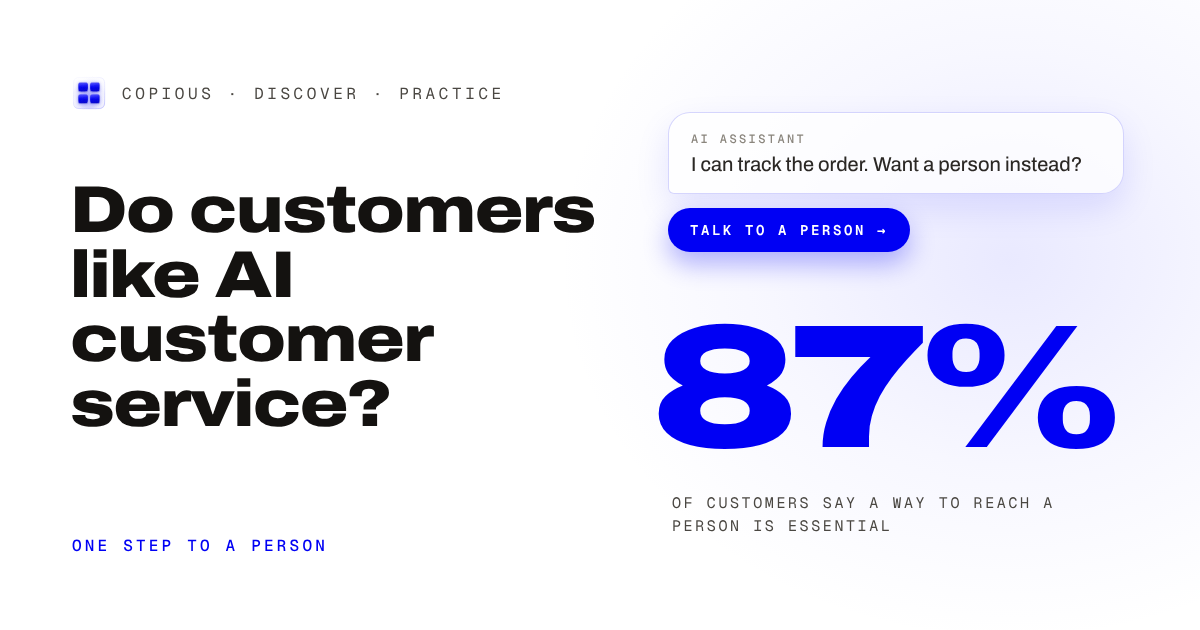
Some do, on their terms. In a Gartner survey of 3,566 customers in February and March 2026, 50% said their service interactions are easier when companies use generative AI, and 87% said a way to reach a person is essential (published Aug 4, 2026). What customers dislike isn't AI. It's AI that stands between them and a person, on problems it can't solve. Give AI the ticket types it resolves, and keep a one-step way to a person on all of them.
TL;DR
- Attitudes moved. In December 2023, 64% of customers would have preferred companies not use AI for service. By early 2026, half said generative AI makes service easier.
- The exit to a person is the condition: 87% call it essential.
- One bad bot closes the channel. Only 27% of customers would try a chatbot again after a negative experience.
- Fit depends on the ticket type: chatbots resolved 58% of returns and cancellations but 17% of billing disputes. Pass: on every ticket type AI handles, a customer who asks for a person reaches one in one step.
Why do so many customers dislike AI customer service?
Because of what it's been used for: keeping them away from a person.
Gartner surveyed 5,728 customers in December 2023. 64% said they'd prefer companies didn't use AI in customer service, and 53% said they'd consider switching to a competitor if they found out a company was going to (published Jul 9, 2024). Their top concern was that AI would make it harder to reach a person. Losing jobs to AI was on the list too.
US regulators heard the same complaint. In June 2023, the Consumer Financial Protection Bureau published a spotlight on chatbots in banking and lending. It described customers caught in "doom loops," going around in circles of unhelpful answers with no way to a human. It found chatbots can handle basic questions but get less useful as problems get more complex. And it warned that a chatbot that blocks access to help can break federal consumer finance law, the same as the process it replaced.
So when people search "why is AI customer service so bad," the usual answer is that a bot was given work it can't finish, and no way out.
Has that changed in 2026?
Yes, customers are more open now. The condition hasn't changed.
From Gartner's survey of 3,566 B2B and B2C customers in February and March 2026:
- 50% say their interactions are easier when companies use generative AI (published Aug 4, 2026).
- 87% say it's essential to offer a way to reach a person when a company uses generative AI. Among customers unwilling to use AI, the most common thing that would change their mind was being able to switch to a person.
- 58% of customers who use generative AI have used it to complete a task for them, and 74% in B2B.
- About three times as many customers used a third-party AI tool, like ChatGPT, Gemini or Copilot, during their most recent service interaction as used the company's own chatbot (published Jul 8, 2026).
- 49% said they would have been willing to use a chatbot if the company had one, but only 7% used one in their most recent interaction. And only 27% would try a chatbot again after a negative experience (published Sep 2, 2026).
Customers are using AI. They're often using their own, and they give a company's bot one chance.
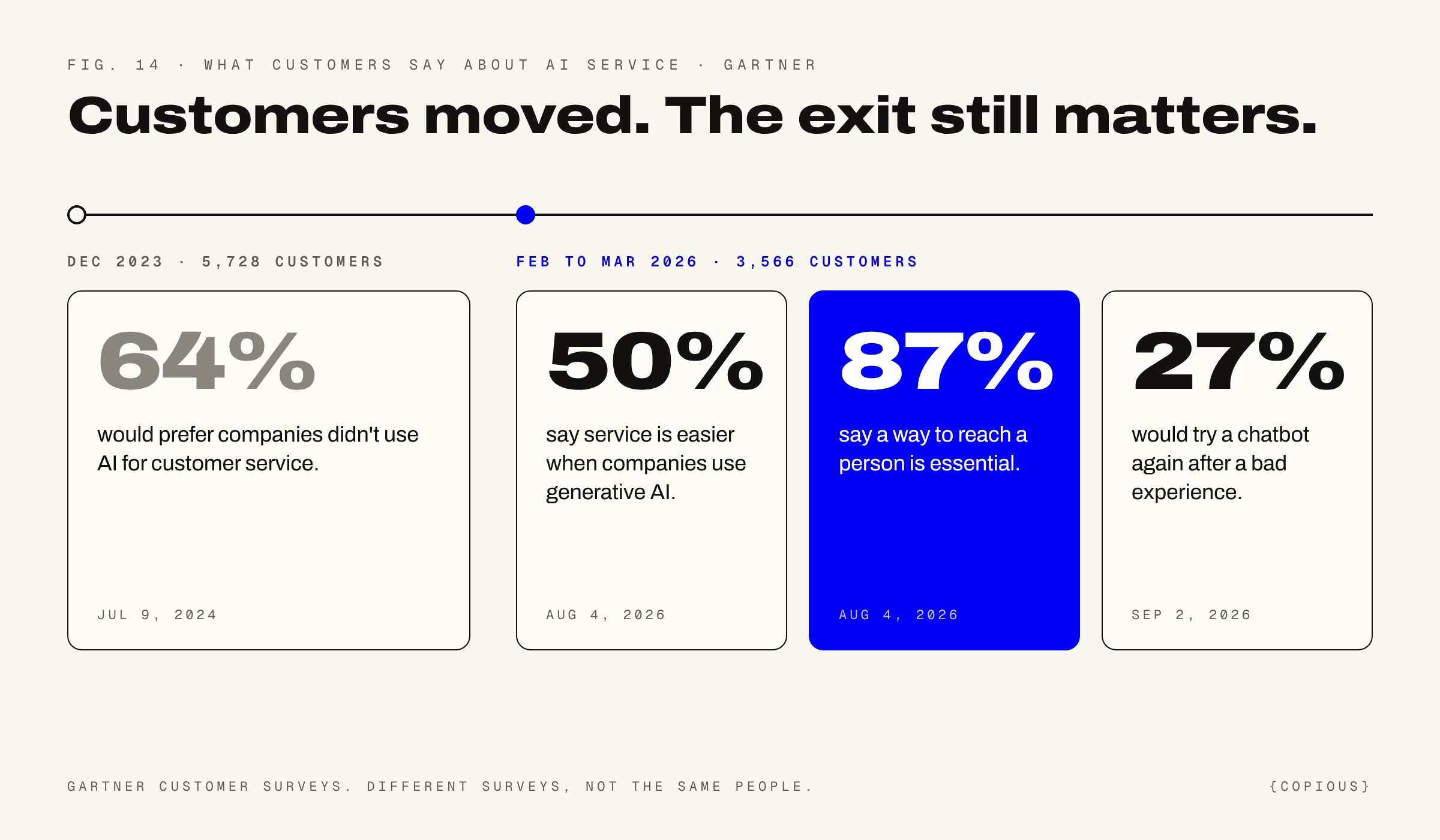
Fig. 14. Customers moved toward AI between 2023 and 2026. The way to a person still decides whether they use it.
Which ticket types do customers accept AI for?
The ones AI resolves. That depends on the ticket type far more than on the bot.
In Gartner's June 2023 survey of 497 customers, chatbot users resolved 58% of returns and cancellations and 17% of billing disputes. Customers didn't sort themselves to match: they were barely more likely to use the bot for one than the other. So the bot took both, and failed on most billing disputes.
That's the pattern we see when ticket types are ruled one at a time. On one real queue, anonymized, order status lookup (310 tickets a month) went to AI. Return and exchange requests (265) went to AI with a person signing off. Billing disputes (120) had no ruling yet. That's the one to decide carefully, not the one to switch on first. (What AI should handle in support.)
What makes customers trust AI in support?
- A visible way to a person, in one step. Not after three failed tries. California adds a right to reach a person in 2027. (Disclosure and "talk to a person" rules by state.)
- AI that knows its limits. Gartner's advice is to use generative AI to gather information and understand intent, and to try to resolve only when confidence is high.
- A handoff that keeps the context. The person picks up where the bot left off. The customer doesn't start over.
- Honesty about what they're talking to. Several states and the EU already require AI disclosure in some cases.
- Not every issue. Don't make AI mandatory for every ticket type. Gartner found forcing customers through repeated failed AI attempts makes them less likely to use it again.
- Measure resolution, not deflection. A deflected ticket that comes back as a phone call isn't a win. (A number worth checking: handoffs.)
How do you test whether customers accept AI on a ticket type?
Run this in your helpdesk, one ticket type at a time:
- Pick one ticket type AI already handles.
- Pull 30 days of those tickets. Split them into AI-handled and person-handled.
- Count reopens and repeat contacts within 7 days. A customer who comes back didn't get an answer.
- Count requests for a person, and how many steps it took to reach one.
- Compare CSAT between the two groups, on the same ticket type.
- Read 20 of the AI conversations end to end. Numbers miss the loops.
Pass: AI-handled tickets reopen no more often than person-handled ones, and every customer who asked for a person reached one in one step. If either fails, the ticket type goes back for a new ruling.
Where Copious fits
Copious helps you decide, one ticket type at a time, whether AI should handle it, a simpler automation should, the process needs fixing first, or your people should keep it. The owner describes the work, Copious suggests a call and shows the words that decided it, and the owner makes the call. Each ruling is filed with its date, its owner and the rules it was checked against, and shows when it needs re-verifying. When a test like the one above fails, that's the ruling to revisit. See pricing.
Copious doesn't build or run chatbots, and it doesn't read your customer conversations unless an owner turns on ticket reading.
Where this doesn't apply
- Surveys measure what customers say. Your own reopen rates, escalations and CSAT by ticket type are better evidence for your queue.
- Gartner's 2026 sample mixes B2B and B2C customers. Consumer-only queues may skew differently.
- The 2023 resolution rates predate most current models. Read them as proof that ticket types differ, not as today's rates.
- The CFPB spotlight is research about consumer finance, not a rule, and the agency's priorities have changed since 2023. Other industries have their own rules.
- Some customers prefer self-service to any conversation. For them, a good help article or order page beats both a bot and a person.
Frequently asked questions
Do customers prefer talking to a human or AI?
Many still trust people more. In a Gartner survey of 5,801 US customers in early 2025, 54% trusted human agents more than AI for product or service recommendations, and 32% trusted AI more. In 2026, half said AI makes service easier, but 87% said a way to reach a person is essential.
Why is AI customer service so bad?
Usually because a bot is given work it can't finish and no way out. In a 2023 Gartner survey, chatbots resolved 58% of returns and cancellations but 17% of billing disputes. When customers with hard problems can't reach a person, they get stuck in what the CFPB called "doom loops."
How can you tell if customer service is AI?
Ask. Some states, including California, New Jersey, Maine and Utah, and the EU already require AI disclosure in some cases. For a support team, the better practice is to say so up front, in the first message, so customers don't have to ask. What each disclosure rule asks.
How do customers get past AI customer service to a person?
Customers often type or say "agent" or "representative" until the bot hands off. If your customers need a trick to reach a person, the exit is too hard to find. In Gartner's 2026 survey, the ability to switch to a person was the most common thing that would win over customers unwilling to use AI.
Does AI improve customer satisfaction?
It can, especially when it helps agents rather than replacing them. In a study of 5,179 support agents, an AI assistant raised issues resolved per hour by 14% and improved customer sentiment. Customer-facing bots help on the ticket types they resolve and hurt on the ones they don't.
Related: Do you have to tell customers they're talking to AI? · What is the 30% rule for AI? · Will AI replace customer service jobs?
Sources
Checked Nov 16, 2026.
- Gartner survey finds 87% of customers say companies using GenAI for customer service must provide access to a human agent · Gartner, Aug 4, 2026
- Gartner survey finds customers are 3x more likely to use third-party GenAI than company-provided chatbots for customer service · Gartner, Jul 8, 2026
- Gartner survey finds only 27% of customers would try a chatbot again after a negative experience · Gartner, Sep 2, 2026
- Gartner survey finds 64% of customers would prefer that companies didn't use AI for customer service · Gartner, Jul 9, 2024
- Gartner survey reveals only 8% of customers used a chatbot during their most recent customer service interaction · Gartner, Jun 15, 2023
- Gartner survey finds 85% of service and support leaders are expanding human agent responsibilities · Gartner, Apr 28, 2026 (for the 2025 trust figures)
- Chatbots in consumer finance · Consumer Financial Protection Bureau, Jun 6, 2023
- Generative AI at Work · Brynjolfsson, Li and Raymond, NBER Working Paper 31161, 2023
Copious helps support and CX leaders decide what AI should handle in their queue and what their people should keep, one ticket type at a time. We take no money from AI vendors.