GOVERNANCE · PRACTICE · REGULATION
OCT 29, 2026
BY COPIOUS
What should AI handle in customer support?
Hand a ticket type to AI when it's high-volume and its rules are written down. Fix broken processes first, and keep the judgment calls with your people.
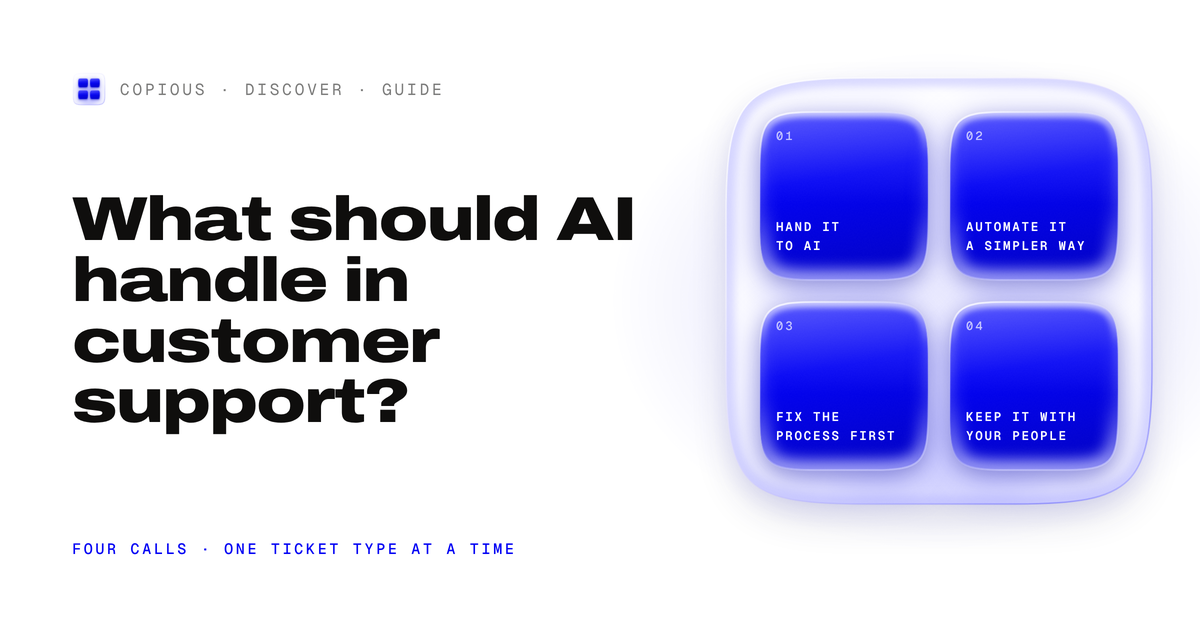
Hand a ticket type to AI when it's high-volume, the rules for it are written down, and a wrong answer is cheap to catch. If refunds or account changes are involved, keep sign-off with a person. If the ticket type already misses its target because it bounces between people, fix the process first. If a rule, macro or form can do the job, use that instead of a model. And if the decision depends on judgment your rules don't cover yet, keep it with your people.
TL;DR
- Decide one ticket type at a time. "Should we use AI in support?" has no single answer.
- There are four honest calls: hand it to AI, automate it a simpler way, fix the process first, keep it with your people.
- In one real, anonymized queue, four ticket types and 650 tickets a month had no ruling at all. That gap is the agenda.
Why is "should we use AI in support" the wrong question?
Because a support queue isn't one job. It's dozens of different requests, each with its own rules, risks and volume.
A ticket type is a kind of request your support queue handles, like "order status lookup" or "refund eligibility." Order status is a lookup with one right answer. Refund eligibility is a judgment with money attached. Treating them the same way is how teams end up with an AI pilot that looks great in a demo and fails on the refund edge case nobody tested.
So ask a smaller question, many times: what should happen with this ticket type?
What are the four calls?
A call is the decision for one ticket type. Written down with a date and an owner, it's a ruling. There are four calls, and they carry equal weight.
1. Hand it to AI. The model does the work, with whatever sign-off you name. Fits ticket types that are high-volume, with written rules and answers you can check.
2. Automate it a simpler way. A rule, macro or form does the job better and cheaper than a model. If every request needs the same five fields and one fixed reply, a form beats a chatbot.
3. Fix the process first. The work is broken before AI touches it. Adding AI to a ticket type that already passes through six people only makes the failure faster.
4. Keep it with your people. The decision depends on judgment your rules don't cover yet. "Yet" matters: once you write the rule, you can decide again.
The last two are wins, not failures. A team that can say no to AI is the team whose yes leadership will believe.
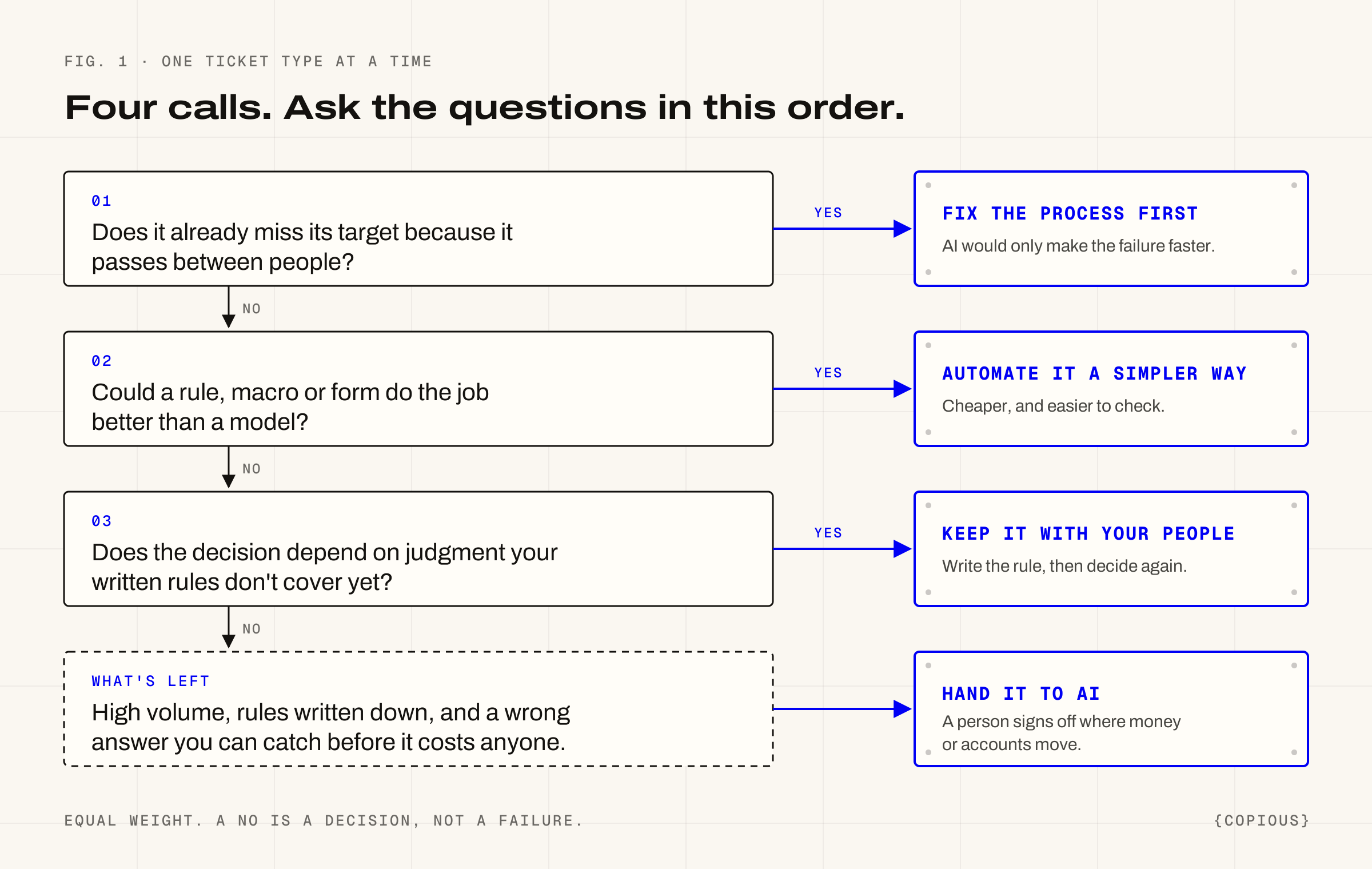
Fig. 1. Ask the questions in this order. Equal weight: a no is a decision, not a failure.
How do you decide, one ticket type at a time?
Ask the questions in this order. The order matters: it stops you from automating something that's broken.
1. List your ticket types by volume. Use the field your help desk already carries: form, type, group, tag or label. If a large share of tickets carries no type at all, count it and write the number down. You can't decide on work you can't see.
2. Check the process. For each ticket type, look at how often it misses its target and how many hands it passes through. In one queue of 6,952 resolved tickets, tickets with six or more handoffs missed their SLA target 92% of the time. A ticket type like that needs its process fixed before anything else. (The handoff data is here.)
3. Ask whether something simpler would do. A macro, a routing rule, a form or a self-serve page. If the answer is yes, build that. It's cheaper to run and easier to check than a model.
4. Ask whether the rules are written down. Not "does someone know the rules." Written, in sentences an agent could follow. If the honest answer is "it depends who you ask," keep it with your people for now.
5. Hand what's left to AI, and name the sign-off. Where money moves or an account changes, a person approves before it goes out.
6. Write each decision down. A date, an owner and the rules it was checked against. Decide again when a rule changes, the model changes, or the volume shifts.
What does this look like in a real queue?
Here's one real queue, anonymized. Every ticket type, ranked by volume, with its ruling or a blank.
- Order status lookup: 310 tickets a month, 8% missed target. Ruling: Hand it to AI.
- Return and exchange requests: 265 tickets a month, 24% missed target. Ruling: Hand it to AI, a person signs off.
- Refund eligibility: 240 tickets a month, 31% missed target. No ruling.
- Shipping exceptions: 195 tickets a month, 44% missed target. No ruling.
- Billing disputes: 120 tickets a month, 52% missed target. No ruling.
- Product troubleshooting: 95 tickets a month, 19% missed target. No ruling.
- Escalation to tier 2: 40 tickets a month, 61% missed target. Ruling: Fix the process first.
Read it from the blanks. Four ticket types, 650 tickets a month, have no ruling at all. Three of those four miss their target more often than either ticket type already handed to AI.
And the one with the worst miss rate, escalation to tier 2 at 61%, isn't an AI question first. Escalations are planned handoffs, but a planned path can still be a slow one. That's why it reads "Fix the process first."
The empty rows are the point. They're the agenda for your next leadership meeting, not a CSAT score.
Which ticket types should stay with people?
Keep it with your people when a wrong answer is expensive and hard to catch, or when the rules depend on judgment nobody has written down. Common examples:
- Refunds and credits outside your written policy.
- Billing disputes, where the customer contests a charge.
- Account closures, fraud claims and anything that changes who can access an account.
- Complaints that could become legal or regulatory issues.
Your company answers for what its AI tells customers. On Feb 14, 2024, British Columbia's Civil Resolution Tribunal held Air Canada responsible for wrong information its website chatbot gave a customer about a bereavement fare refund, and ordered it to pay CA$812.02 (Moffatt v. Air Canada, 2024 BCCRT 149). On Oct 20, 2026, New York City's Department of Consumer and Worker Protection proposed a rule saying that relying on a technology is not a defense for a violation. That rule is a proposal, not law.
Should you measure AI in support by deflection rate?
Not by itself. A deflection rate counts tickets that never reached a person. It doesn't show whether those customers came back, or how many hands the remaining tickets passed through.
Read it next to repeat contacts and handoffs per ticket type. If deflection rises while repeat contacts rise too, the bot may be moving work around rather than resolving it.
Where this doesn't apply
- If you want a vendor shortlist, this is the wrong guide. We don't rank AI vendors, and we take no money from any of them.
- If a ticket type shows up a few times a month, a person answering it is usually the cheapest call. Count before you build.
- If you're in a regulated industry such as healthcare, financial services or insurance, have counsel review which ticket types AI may touch. This is not legal advice.
- This decides what AI should handle. It doesn't pick the model or write the prompt. Those come after the call.
Frequently asked questions
Can AI handle refunds?
AI can draft refund replies and gather the facts. Whether it should decide eligibility depends on whether your refund rules are written down and how costly a wrong call is. Where money moves, most teams keep a person signing off. Refund decisions that depend on judgment your rules don't cover yet stay with your people.
How often should we revisit these decisions?
Whenever a rule changes, the model changes, or a ticket type's volume or miss rate shifts. Put a date on every decision so you can see which ones are old. A decision nobody has checked since the rules changed should be marked as needing review, not trusted.
Do customers have to be told they're talking to AI?
In some places, yes. New York City's proposed rule (Oct 20, 2026) would require disclosure at the start of an automated interaction, and it cites similar disclosure measures in California, Maine, New Jersey and Utah. The rules differ by place and change often, so check with counsel for where your customers are.
What's the difference between "automate it a simpler way" and "hand it to AI"?
"Automate it a simpler way" means a rule, macro or form, with a fixed path and no model. "Hand it to AI" means a model reads the request and writes or takes the next step. If a fixed path gets the right answer every time, it's usually cheaper and easier to check than a model.
Where Copious fits
Copious works through the same four calls. It reads the shape of your queue and lists your ticket types by volume. You describe a ticket type, Copious suggests one of the four calls and shows the words that decided it, and you file the ruling with a date and your name. If you'd rather work in a spreadsheet, the six steps above work there too.
Related: Do ticket handoffs predict SLA misses? · How to write an AI usage policy support agents will actually follow · The Desk 05: New York City's one-step rule
Copious helps support and CX leaders decide what AI should handle in their queue and what their people should keep, one ticket type at a time. We take no money from AI vendors.