GOVERNANCE · SAFETY · PRACTICE
NOV 27, 2026
BY COPIOUS
What to ask an AI vendor before your support conversations go into it
Before customer conversations go into an AI tool, get written answers on training, retention, deletion, sale or shutdown, and what the AI can do in your help desk.
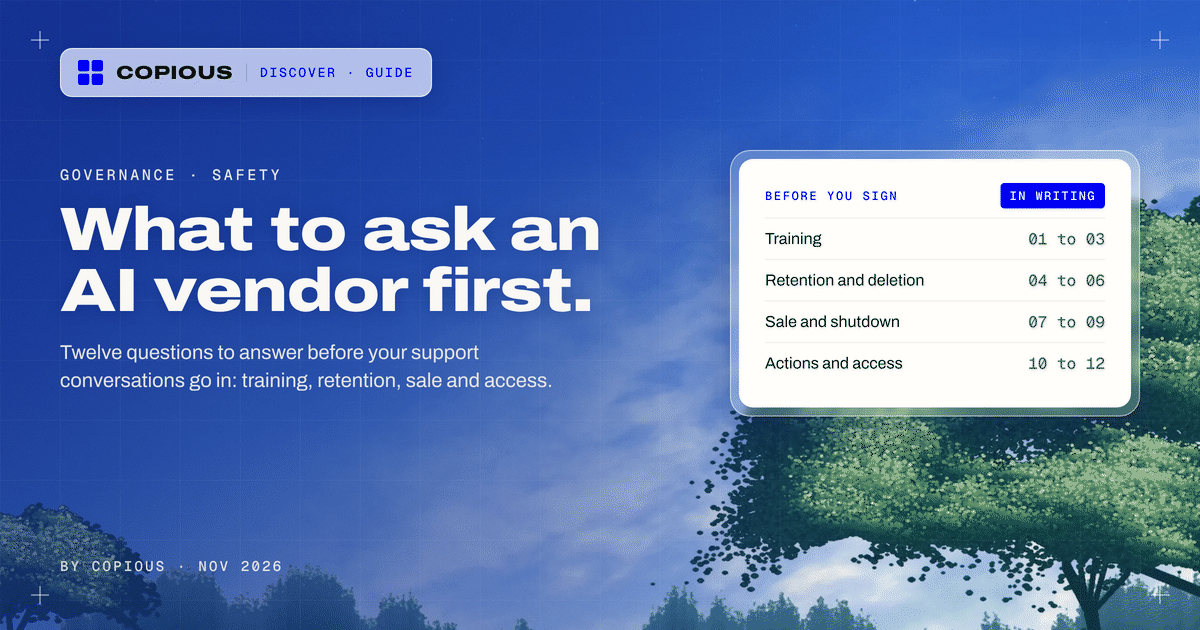
Before any customer conversation goes into an AI tool, get written answers to four things: whether your data trains anyone's models, how long it's kept and how deletion works, what happens to it if the vendor is sold or shuts down, and what the AI can do inside your systems. Get the answers in the contract, not the sales deck. Below are the 12 questions to send, and what a good answer looks like.
TL;DR
- Support conversations hold names, orders, complaints and sometimes payment or health details. Treat every AI tool that sees them as a place that data now lives.
- Ask 12 questions in four groups: training, retention and deletion, sale and shutdown, actions and access.
- A good answer is specific and written into a contract document. "We take security seriously" isn't an answer.
- Copy the email at the end of this guide and send it before you sign or renew.
Why ask now?
Three reasons from this year and last.
Chat logs are being sold as assets. On Nov 23 and Nov 24, 2026, Minnesota's and California's attorneys general announced that a coalition of attorneys general is asking a bankruptcy court to reject the sale of Character.AI users' chats. Minnesota's release says the chats, "together with users' personal data, including IP addresses and other metadata, are set to be sold at auction on December 1, 2026," and adds: "The buyer would not have to follow Character.AI's privacy policies." Character.AI is a consumer app, not a support tool. The question it raises applies to every vendor that holds your conversations.
Regulators expect AI companies to keep their promises. In January 2024 the FTC warned that model-as-a-service companies must keep "promises made by companies that they won't use customer data for secret purposes, such as to train or update their models," and "must also abide by their commitments to customers regardless of how or where the commitment was made." In February 2024 it added that "it may be unfair or deceptive for a company to adopt more permissive data practices" through a quiet, retroactive change to its terms.
Lawmakers are writing chat-log rules. New Jersey's A5607, introduced Oct 5, 2026, would bar chatbot providers from selling a user's chat log and from keeping it longer than two years. It's a bill, not a law, but it shows where the questions are heading.
The 12 questions
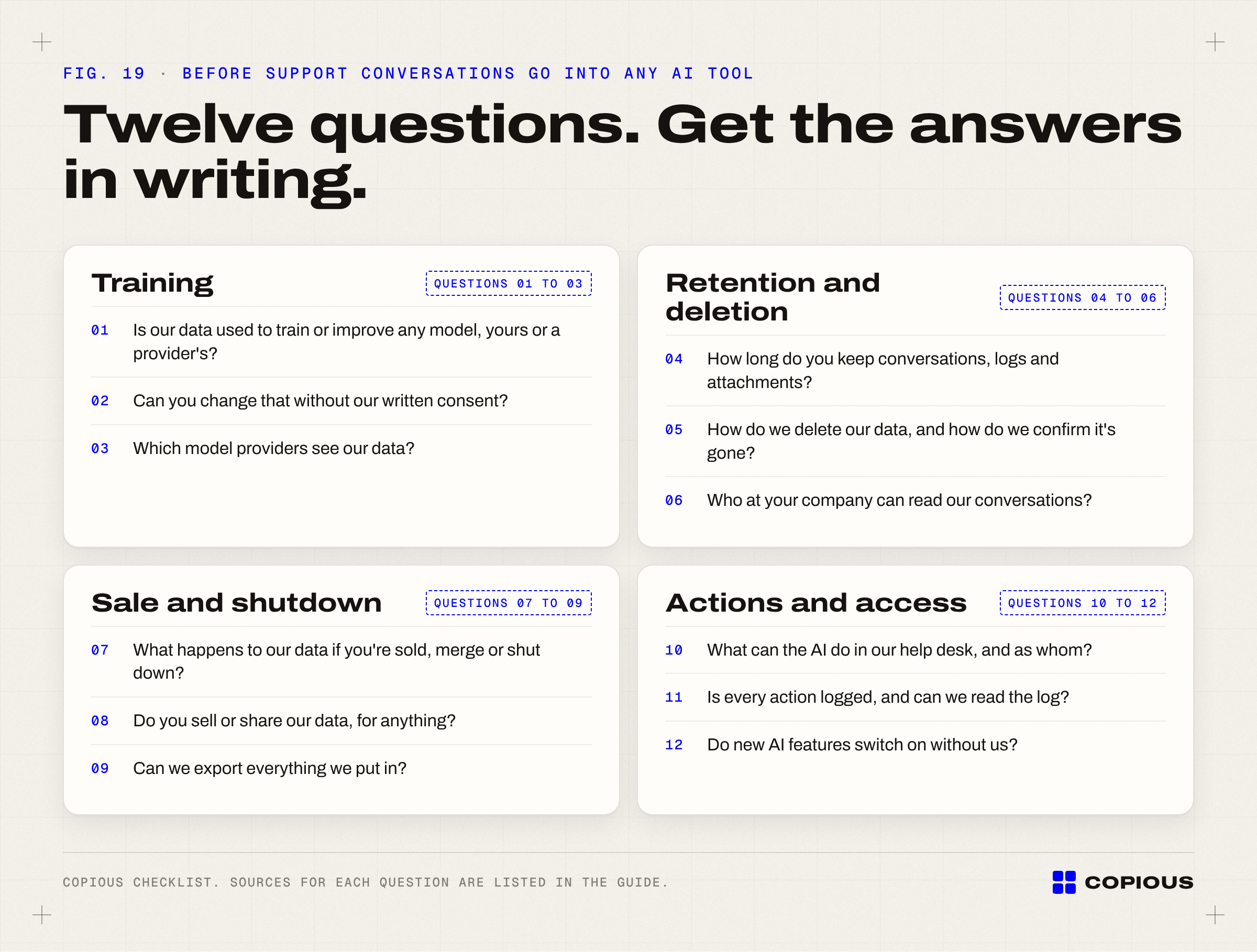
Training
1. Is our data used to train or improve any model, yours or a provider's? Why it matters: once a conversation is in training data, you can't take it back. A good answer says no, by default, for business accounts, in writing. For example, OpenAI's enterprise privacy page says: "By default, we do not use your business data for training our models."
2. Can you change that without our written consent? Why it matters: terms change. The FTC has warned against quiet, retroactive changes. A good answer: changes to data use need notice and your agreement, and they don't apply to data you already sent.
3. Which model providers see our data? Why it matters: many AI tools send your text to another company's model. A good answer names each provider, says what they're allowed to do with it, and promises notice before the list changes.
Retention and deletion
4. How long do you keep conversations, logs and attachments? Why it matters: data that's kept is data that can be breached, subpoenaed or sold. A good answer is a number of days, plus a setting your admin controls. OpenAI's API page, for example, says inputs and outputs may be kept "for up to 30 days to provide the services and to identify abuse."
5. How do we delete our data, and how do we confirm it's gone? A good answer: deletion on request, a stated time for it to complete, and written confirmation, including backups and logs.
6. Who at your company can read our conversations? A good answer names when staff can look (for example, to resolve an incident you report), says every access is logged, and says you can see that log.
Sale and shutdown
7. What happens to our data if you're sold, merge or shut down? Why it matters: this is the Character.AI question. A good answer: your data is returned or deleted, it doesn't transfer as an asset, and any buyer is bound by the same terms.
8. Do you sell or share our data, for anything? A good answer is no, with no exceptions buried in a privacy policy. If you're covered by California's privacy law, its regulations require a service provider's contract to prohibit "retaining, using, or disclosing the personal information" for anything other than the business purposes written in that contract.
9. Can we export everything we put in? A good answer: yes, in a usable format, at any time, including after you cancel.
Actions and access
10. What can the AI do in our help desk, and as whom? Why it matters: AI agents now take actions, not only write replies. A good answer: no access by default, and you grant each action. Zendesk's setup article for outside AI agents says: "By default, external AI agents have no access. An external agent can use only the Zendesk tools you explicitly grant it access to."
11. Is every action logged, and can we read the log? A good answer: every action is logged with which AI did it and on whose behalf, and your admins can read it.
12. Do new AI features switch on without us? Why it matters: vendors add AI features to existing accounts. Zendesk's free trial notice of Nov 10, 2026, for example, says "additional AI features may be added to your account" before Jan 31, 2027. A good answer: nothing new runs on your customers' conversations until an admin turns it on.
What does a good answer look like?
Specific, and written down in a document you can point to later.
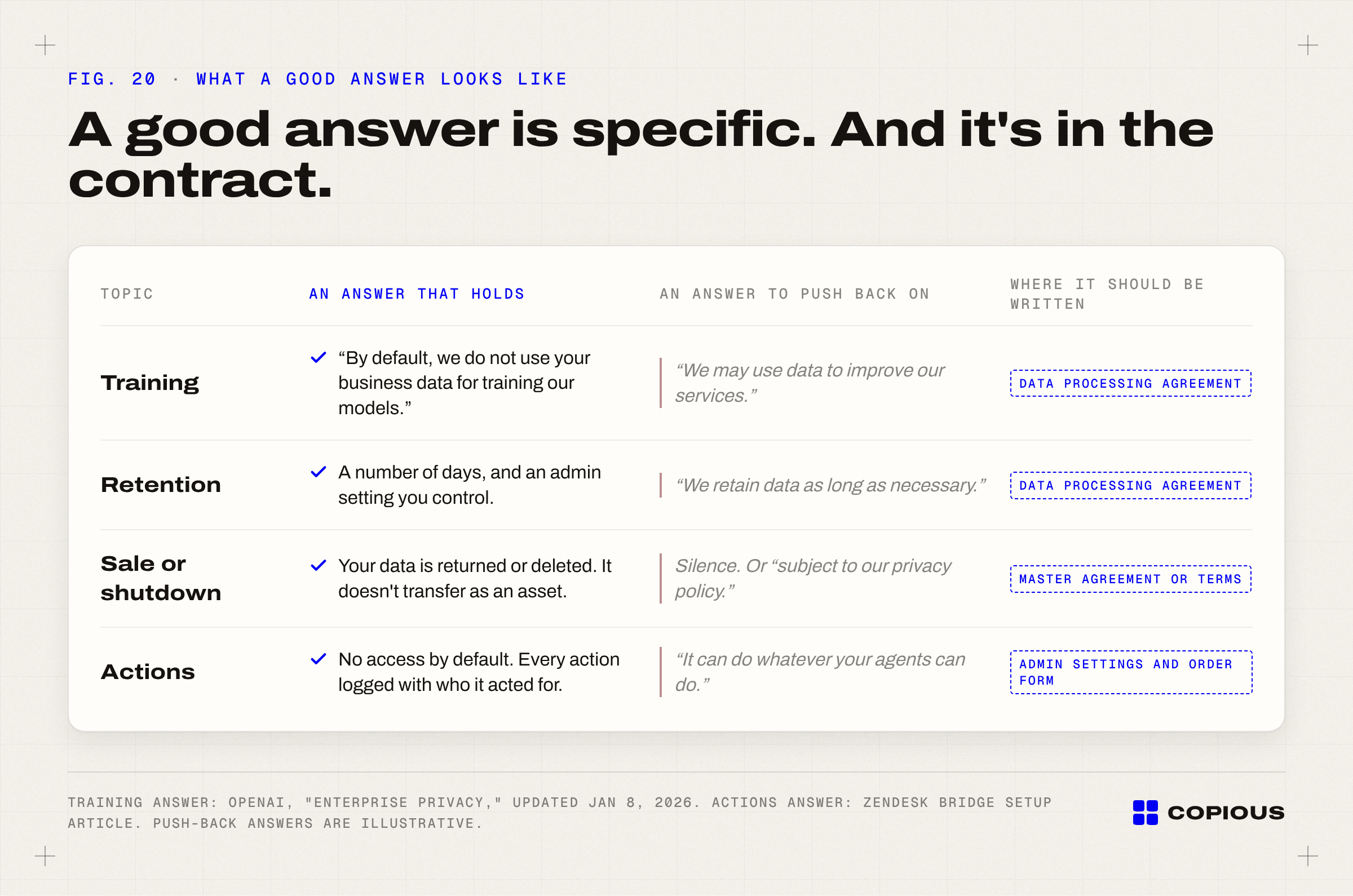
Answers to push back on:
- "We take security seriously." That's a sentiment, not a term.
- "We may use data to improve our services." Ask: which data, which models, and can we opt out in writing?
- "We retain data as long as necessary." Ask for a number of days.
- "See our trust center." Ask which line in which document answers the question.
- Silence on sale or shutdown. Ask again, in writing.
Where should each answer be written?
- Data processing agreement (DPA): training, retention, deletion, subprocessors, staff access. Most business vendors offer one; ask for it.
- Master agreement or terms of service: sale, merger and shutdown, and how terms can change.
- Order form: anything specific to your deal, such as a shorter retention period.
- Admin settings: what the AI can do and who can turn features on. Screenshot them when you go live.
The email to send
Copy this, add your vendor's name, and send it before you sign or renew:
Before we put customer support conversations into [product], please answer these in writing and tell us which document each answer is in (DPA, terms, order form or admin settings):
- Is our data used to train or improve any model, yours or a provider's?
- Can that change without our written consent?
- Which model providers see our data?
- How long do you keep conversations, logs and attachments?
- How do we delete our data, and how do we confirm it's gone?
- Who at your company can read our conversations, and is that logged?
- What happens to our data if you're sold, merge or shut down?
- Do you sell or share our data for any purpose?
- Can we export everything we put in, including after we cancel?
- What can the AI do in our help desk, and as which user?
- Is every action logged, and can our admins read the log?
- Do new AI features switch on for our account without an admin's approval?
Pass line: every one of the 12 has an answer that names a document, and none of them is "we take security seriously."
Where this doesn't apply
- This isn't legal advice. Your legal and security teams decide what's acceptable. These questions help you get them a complete answer faster.
- Consumer tools. You can't negotiate the terms of a free personal chatbot account. The fix there is your AI policy: which tools agents may use, on which accounts. Our guide on whether ChatGPT is safe for customer data covers it.
- Large enterprise deals. You'll likely negotiate a full security review. Use the 12 as a checklist that nothing support-specific got missed.
- Vendors change. The examples quoted here were checked Nov 26, 2026. Ask your vendor for its current wording.
Frequently asked questions
What should I ask an AI vendor about data privacy?
Ask four things in writing: whether your data trains any model, how long it's kept and how deletion is confirmed, what happens to it if the vendor is sold or shuts down, and what the AI can do in your systems. Ask which contract document holds each answer, usually the data processing agreement or the terms.
Do AI vendors train on business customer data?
It depends on the vendor and the plan. Many business plans say they don't train on customer data by default. OpenAI's enterprise privacy page says so for its business products, for example. Personal and free accounts often work differently. Get the answer for your plan in writing, and ask whether it can change without your consent.
What happens to my data if an AI vendor goes bankrupt?
Unless your contract says otherwise, data can be treated as an asset in a sale. In November 2026, a coalition of state attorneys general asked a bankruptcy court to reject the sale of Character.AI users' chats. Ask vendors to commit in writing that your data is returned or deleted, not transferred.
Where should an AI vendor's answers be written?
Training, retention, deletion and subprocessors belong in the data processing agreement. Sale, merger, shutdown and term changes belong in the master agreement or terms of service. Deal-specific terms go in the order form. What the AI can do lives in admin settings, so screenshot them when you go live.
Who should send these questions, support or procurement?
Either, but support should own the answers. The support leader knows what's in the conversations and which actions an AI could take in the help desk. Procurement and security know which documents to check. Send the email together, and file the answers with the decision.
Where Copious fits
Copious keeps a support team's AI policy, tracks who signed it, and records what AI is allowed to handle, one ticket type at a time. When a vendor's answers come back, they belong with the decision they support: which ticket types the tool may handle, who decided, and on what date. By default, Copious reads the shape of your queue, not the contents, and ticket text is never stored. Our current answers are on our security page, our privacy page and in what Copious reads. We take no money from AI vendors and we don't rank them. Start free at copious.app, no card.
Related: Is it safe to put customer data into ChatGPT? · How to write your company's first AI policy · What is shadow AI?
Sources
- Minnesota Attorney General, press release on the Character.AI sale, Nov 23, 2026
- California Attorney General, Attorney General Bonta opposes asset sale of Character.AI, Nov 24, 2026
- FTC, AI Companies: Uphold Your Privacy and Confidentiality Commitments, Jan 9, 2024
- FTC, AI (and other) Companies: Quietly Changing Your Terms of Service Could Be Unfair or Deceptive, Feb 13, 2024
- New Jersey Legislature, A5607, as introduced, Oct 5, 2026
- California Privacy Protection Agency, CCPA regulations, § 7051, effective Jan 1, 2026
- OpenAI, Enterprise privacy, updated Jan 8, 2026
- Zendesk Help Center, Understanding Zendesk Bridge and allowing external AI agents to perform actions in Zendesk, checked Nov 26, 2026
- Zendesk Help Center, Announcement: Try new AI features free for a limited time, Nov 10, 2026