GOVERNANCE · PRACTICE · SAFETY
NOV 8, 2026
UPDATED NOV 17, 2026
BY COPIOUS
Your agents draft replies in ChatGPT. Have they signed your AI policy?
A reply drafted in ChatGPT or Gemini is AI use on customer data. Why every agent should sign the current AI policy, what to put in it, and how to run it.
Yes. If anyone on your support team uses ChatGPT, Gemini or any other AI tool to draft a customer reply, they're using AI on customer data, and they should have signed the current version of your AI policy. A signature doesn't make anyone careful. It records that each person was given the rules that apply to them, which version, and when. When the policy changes, they sign the new version, and the old signatures stay on record.
TL;DR
- Drafting a reply in a chatbot counts as using AI. The customer's words, name and order details go into the tool.
- On personal ChatGPT accounts, what's pasted in can be used to improve the models unless the person turned that off. On Gemini, the same happens while Keep Activity is on.
- A signed version is your record that the rules reached the person typing. A link in Slack isn't.
- Ask for a new signature on every new version. Pass: you can say who signed the current one, with dates, in under a minute.
Does drafting a reply in ChatGPT count as using AI?
Yes. An agent who pastes a customer's email into ChatGPT and asks for "a calmer reply" has put customer data into an AI tool, and is about to send its words under your company's name. That's exactly the use an AI policy exists for, even if nobody bought the tool.
It's common. In Microsoft and LinkedIn's 2024 Work Trend Index, 75% of knowledge workers said they use AI at work, and 78% of those users brought their own AI tools (31,000 people in 31 countries, published May 8, 2024). In ISACA's 2026 AI Pulse Poll of more than 3,400 digital trust professionals, 38% said their organization has a formal, comprehensive AI policy, and 25% said it has no active policy (published May 5, 2026).
What happens to the pasted text depends on the account:
- Personal ChatGPT accounts. OpenAI's help center says that on Free, Plus and Pro plans in a personal workspace, sharing conversations to improve its models is on by default. The person has to switch off "Improve the model for everyone" under Data Controls. OpenAI says its Business, Enterprise, Edu and API offerings don't use inputs and outputs for training by default.
- Personal Gemini accounts. Google's Gemini Apps privacy page (updated Oct 26, 2026) says that with Keep Activity on, activity is used to improve Google services, including training generative AI models, and that a subset of conversations is read by human reviewers. Reviewed conversations are kept for up to three years, even after the person deletes their activity. Google advises against entering confidential information you wouldn't want a reviewer to see. Work and school accounts can have different rules.
None of that means the tools are off limits. It means the rule has to be written down, and the person typing has to have read it.
What can go wrong with an AI-drafted email?
Three things, and only one of them is about the tool.
Customer data goes somewhere you didn't approve. A name, an address, an order number or account details end up in a personal account your company doesn't control, under settings nobody checked.
A promise goes out under your name. The agent sends the draft. If it says the refund is approved, the warranty covers it or the fee is waived, that's your company's promise now, whoever wrote the first draft. On Feb 14, 2024, British Columbia's Civil Resolution Tribunal held Air Canada responsible for wrong refund information its website chatbot gave a customer (Moffatt v. Air Canada, 2024 BCCRT 149). The tribunal rejected the idea that the chatbot was a separate entity responsible for its own words. A draft your agent pasted and sent is even more plainly yours.
People follow the old rules. Policies change. A tool gets approved, a data rule gets stricter, a ticket type moves to "a person decides." If nobody signs the new version, you can't say who has read it, and the agent on the night shift is working from last spring's PDF.
Why ask agents to sign instead of sharing a link?
Because a link shows the policy exists. A signature records who was given which version, and when.
Signing the policy means a person opens the current version and confirms they've read it, and the record keeps their name, the version and the date. It's an acknowledgment, not a contract.
That record answers the questions that come after something goes wrong, and before a customer signs a contract with you. Did this agent have the rule? Which version was in force that day? Who still hasn't read the new one?
It isn't a new habit. Teams near payment data already do it for security: PCI DSS v4.0.1 requirement 12.6.3 asks that personnel acknowledge, at least once every 12 months, that they've read and understood the information security policy and procedures. ISO/IEC 42001:2023, the standard for running an AI management system, has a clause on the AI policy and a clause on awareness. An AI policy belongs in the same routine.
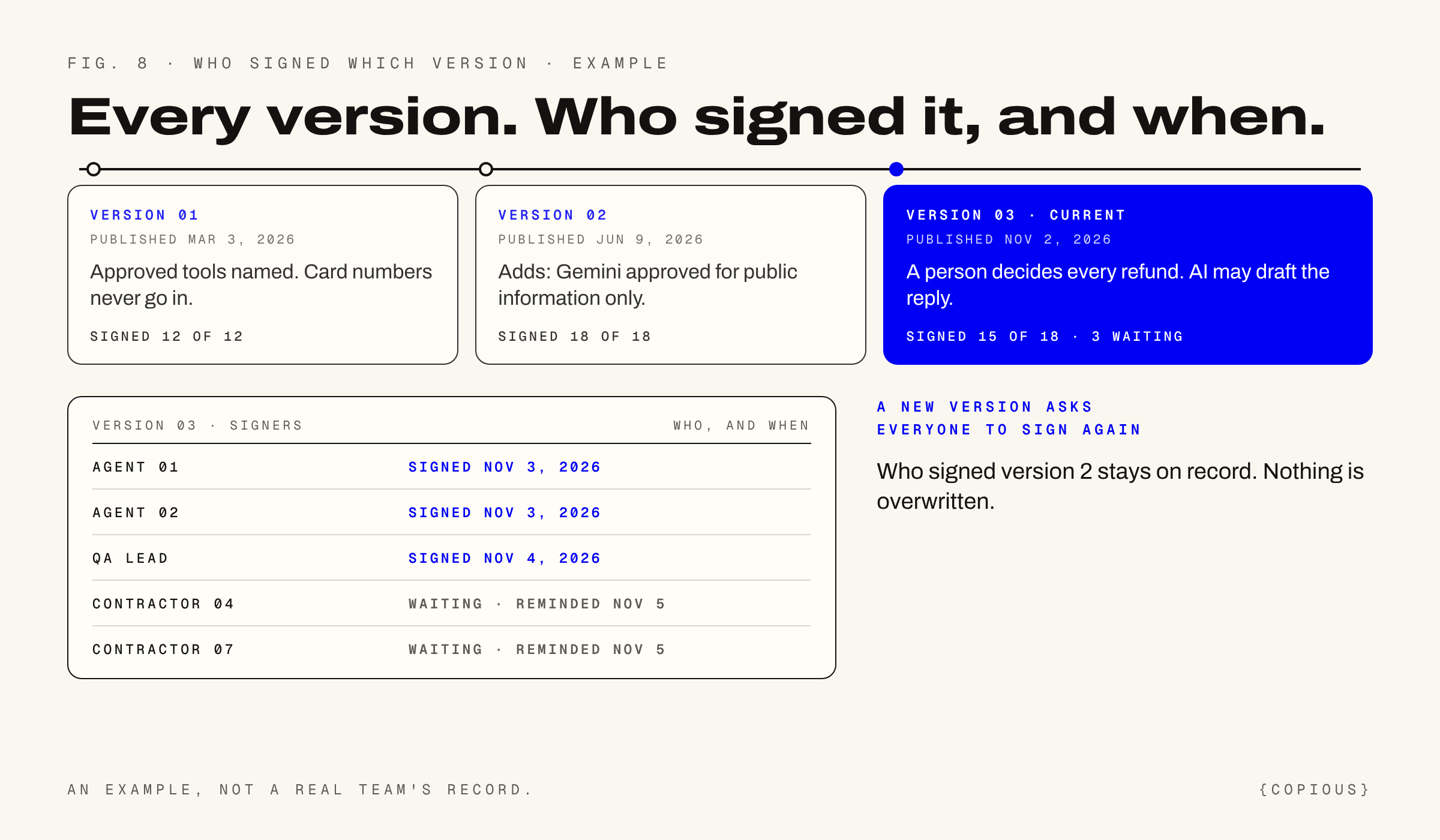
Fig. 8. Every version kept, and who signed each one. An example, not a real team's record.
What should support agents sign?
One page they can apply mid-ticket. Write it for the person typing, not for the board. (How to write the company-wide policy, and the support team's rules under it.)
From what they signed, an agent should be able to answer five questions:
- Which tools are approved for customer data, and what's allowed in everything else (usually public information only).
- What never goes into any AI tool: payment card numbers, passwords, government ID numbers, and anything your contracts forbid.
- Which decisions a person makes. Refunds, credits, exceptions and account changes are the usual start. AI may draft. A person decides.
- What gets checked before sending. The agent reads every AI-drafted reply before it goes out, and anything that promises money, a date or an exception is checked against the rule.
- What to do when something goes wrong. Who to tell, and how fast, if customer data went into the wrong tool or a wrong answer reached a customer.
How do you run signing without a mess?
1. Publish one current version. One owner, one date, a version number. Drafts don't get signed. A published version doesn't get edited; a change makes a new version.
2. Send it to everyone who touches customer messages. Agents, team leads, QA, contractors and outsourced teams. If they can paste a customer's words into a tool, they sign.
3. Track who has signed and who's waiting. Remind the people waiting. Don't chase signatures in a spreadsheet.
4. Ask for a new signature on every new version. Keep who signed the old one. What was in force last month matters as much as what's in force today.
5. Make it part of day one. New agents sign before they use AI tools on tickets, not at their 30-day review.
6. Keep the record ready to hand over. When leadership, security, procurement or an insurer asks, you send the record. You don't rebuild it.
Pass: someone asks who has signed the current version of your AI policy, and you answer in under a minute, with names and dates, including who hasn't. If the answer starts with "let me check the shared drive," it fails.
Where Copious fits
Copious keeps your AI policy in the Policy. Owners write the policy in Copious, have Copious write v1 from eight answers about the company and its AI tools, or bring it in, and publish versions; every published version is kept. Signers get an email link, read the current version, tick a box and sign, with no account and no password. Owners see who signed and when, and who's still waiting, and anyone who hasn't signed gets a reminder. Publish a new version and signers are asked to sign again, while earlier signatures stay on record. Every edit, publish and signature is filed with a date and a name, and owners can export the record. Signers never see your rulings. Turn a section of the policy into a rule, and the Check applies it to prompts run through it. The Policy is on paid plans; see pricing.
A v1 Copious writes is a starting draft, not legal advice. The owner edits it before anyone is asked to sign.
Step by step in the Copious docs: Ask people to sign the policy · Roll out your AI policy and get it signed
Where this doesn't apply
- This isn't legal advice. We know of no general US law that requires support agents to sign an AI policy. If you're in a regulated industry, or you want the signature to carry contractual weight, have counsel review the policy and the process.
- A signature isn't training. It records that a person was given the rules. It doesn't show they understood them or follow them. In ISACA's 2026 poll, 33% said their organization trains all employees on AI. Spot-check AI-drafted replies, and treat a rule people keep breaking as a rule to rewrite.
- A ticked box isn't an e-signature on a contract. It acknowledges a version. If you need more than that, ask counsel.
- Approved business tools change the data risk, not the promise risk. A plan that doesn't train on your data still drafts replies your agent sends under your name.
- A ban isn't a policy. Without an approved alternative, AI use moves out of sight.
Frequently asked questions
Do employees have to sign an AI policy?
Not under any general US law we know of. Companies ask for it because it creates a record of who was given which version, and when. Some frameworks already expect this for related policies: PCI DSS asks personnel to acknowledge the information security policy at least once every 12 months. If you need the signature to be binding, ask counsel.
How often should support agents sign the AI policy?
Every time you publish a new version, and at least once a year even if nothing changed. Publish a new version only when something real changes, so signing stays meaningful. Keep earlier signatures. If something goes wrong, the question will be which version was in force that day and who had signed it.
Do contractors and outsourced agents need to sign the AI policy?
Yes, if they read or answer your customers' messages. They're the people most likely to use their own tools and least likely to see your internal channels. Put signing in the onboarding for every vendor team, not only your own staff, and track their signatures the same way.
Is it safe to use ChatGPT to draft customer emails?
It depends on the account and what goes in. OpenAI's help center says model-improvement sharing is on by default on personal Free, Plus and Pro plans until the person turns it off, and its business plans don't train on inputs by default. Your policy should name which tools are approved for customer data, and the agent should read every draft before it's sent.
What's the difference between signing the AI policy and training on it?
Signing records that a person was given the current version and confirmed they read it. Training teaches them how to apply it. You need both. A signature with no training is a formality, and training with no signature leaves no record of which rules a person was given.
Related: How to write your company's first AI policy · How to write an AI usage policy support agents will actually follow · Insurance and compliance are moving to active AI governance
Sources
Checked Nov 1 to Nov 7, 2026.
- What if I want to keep my history on but disable model training? · OpenAI Help Center
- Gemini Apps Privacy Hub · Google, updated Oct 26, 2026
- PCI DSS v4.0.1, requirement 12.6.3 · PCI Security Standards Council, June 2024
- ISO/IEC 42001:2023 · ISO
- Microsoft and LinkedIn release the 2024 Work Trend Index · Microsoft, May 8, 2024
- AI use accelerates while governance and ROI lag · ISACA, May 5, 2026
- Moffatt v. Air Canada, 2024 BCCRT 149 · BC Civil Resolution Tribunal, Feb 14, 2024
Copious helps support and CX leaders decide what AI should handle in their queue and what their people should keep, one ticket type at a time. We take no money from AI vendors.