GOVERNANCE · REGULATION · SAFETY
NOV 8, 2026
UPDATED NOV 17, 2026
BY COPIOUS
Insurance and compliance are moving to active AI governance
AI exclusions, coverage built on tested evidence and laws that reward records point one way: show your AI rules working. What an active program looks like.
Insurance and compliance are converging on one question: can you show your AI rules working today, not only that someone wrote them once? Since January 2026, insurers have had standard, optional generative AI exclusions they can add to general liability policies. At least one large insurer's AI exclusion names inadequate AI policies and training as a source of claims. Coverage written for AI on purpose has been underwritten on tested evidence. And Texas law can shield a company that finds a violation through its own internal review while substantially complying with a recognized AI risk framework. We expect companies that can hand over a current policy, its earlier versions and who signed each one to be better placed at renewal and in audits.
TL;DR
- AI is being written out of some standard coverage. The ISO generative AI exclusions are optional, but filings to use them are rising.
- Where AI has been insured on purpose, the coverage was made possible by evidence someone outside the company could check.
- Laws are rewarding documented frameworks and records, not good intentions.
- An active program can show, on any given day, the current policy, its owner, who signed it, what changed and what happened when something went wrong.
What is an active AI governance program?
An active AI governance program is a set of AI rules your company keeps current and can prove on any given day: a named owner, a published policy version, a record of who signed it, dated rules for the work AI touches, and a log of changes and incidents.
The opposite is a paper program: a policy approved once and saved in a shared drive, with no record of who read it or what changed since. Both get called "our AI policy." Only one survives a follow-up question.
| What you're asked | Paper program | Active program | |---|---|---| | Do you have an AI policy? | A PDF from last spring | Version 3, published Nov 2 | | Who owns it? | Whoever wrote it | A named owner, on the policy | | Who has read it? | Unknown | 15 of 18 signed, 3 reminded | | What changed since the last version? | Nobody's sure | Every version kept, with what changed | | What happens before AI output reaches a customer? | "Agents use judgment" | A written rule per ticket type, with who decides | | Can you send the record? | In a week, maybe | Exported the same day |
The answers in the right-hand column are an example, not a benchmark.
What's changing in insurance?
AI is being written out of some standard coverage. Verisk's ISO, which writes standard policy forms many insurers use, made three optional generative AI exclusions available with a January 2026 edition date: CG 40 47 and CG 40 48 for commercial general liability, and CG 35 08 for products and completed operations. They're optional, and a Verisk executive told Insurance Journal he didn't know how many insurers had adopted them. But filings to use them are increasing, a coverage attorney said in the same Jul 22, 2026 report.
Some exclusions name governance itself. Berkley's absolute AI exclusion for its D&O, E&O and fiduciary liability products, as described by the law firm Hunton Andrews Kurth on May 28, 2025, reaches claims tied to an insured's "inadequate or deficient" AI policies, practices, procedures or training, or a failure to develop or implement them. Read it from the other side: one of the claims an insurer expects is that your AI governance wasn't good enough.
Applications ask about AI. The same Hunton analysis told policyholders to watch for AI-use questions on insurance applications and answer them carefully, because AI use changes fast enough to outdate an answer before the next renewal.
Coverage written for AI rests on evidence. On Feb 12, 2026, ElevenLabs said it had gone live with an insurance policy for its AI voice agents, covering cases such as an agent giving a customer incorrect information, enabled by certification against AIUC-1, a standard from the Artificial Intelligence Underwriting Company. ElevenLabs said its agents went through 5,835 technical tests across 14 risk categories. That's an AI vendor insuring its own product after a third party tested it, not a support team insuring its policy. It's one example, but it shows what made the coverage possible: records someone outside the company could check.
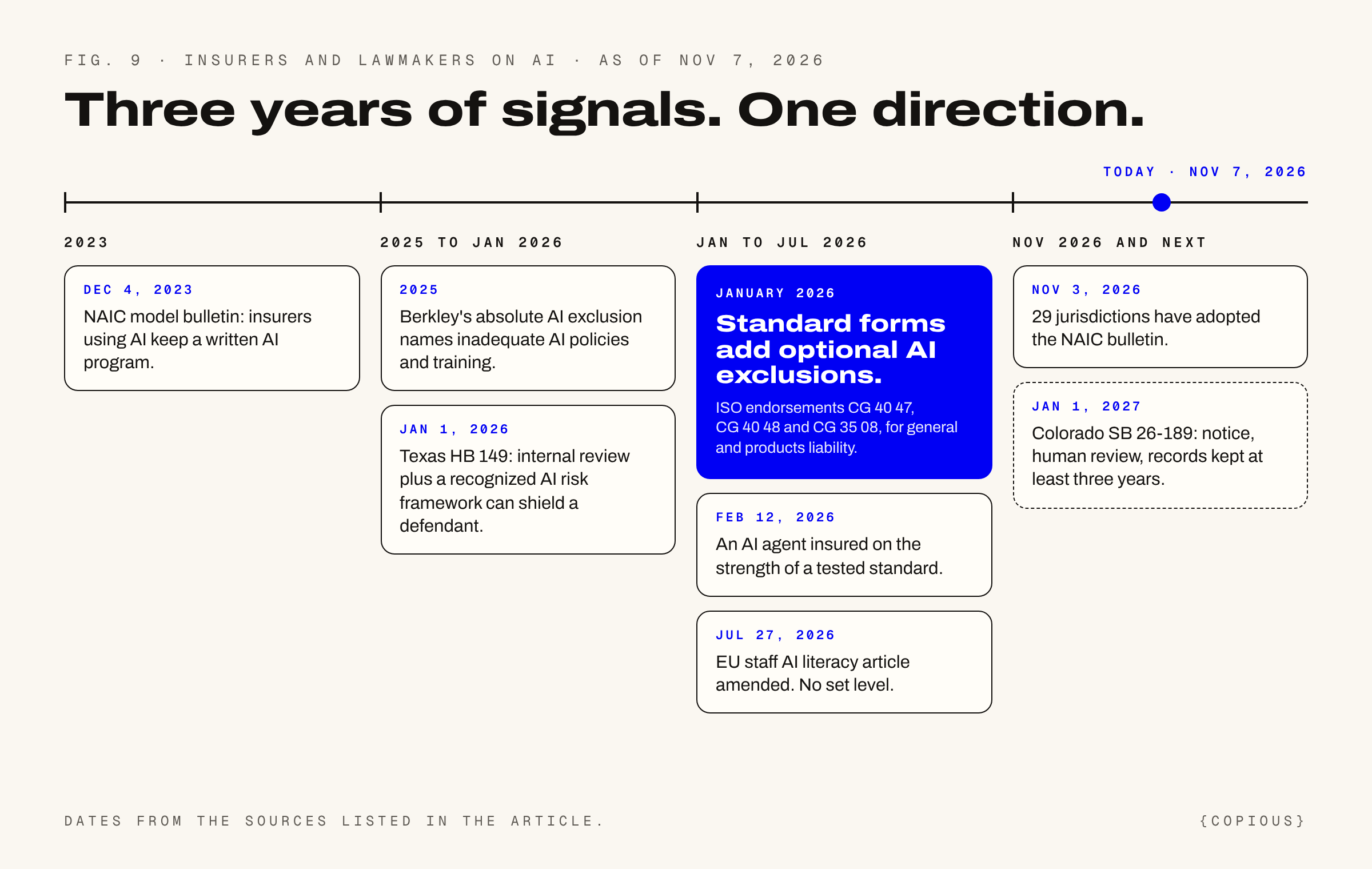
Fig. 9. Three years of signals, one direction: show the record. Dates from the sources listed below.
What do insurers have to do themselves?
Run a written AI program. The National Association of Insurance Commissioners adopted a model bulletin on Dec 4, 2023 that expects insurers using AI to develop, implement and maintain a written program for the responsible use of AI systems, with governance, risk controls and oversight of third-party vendors. As of Nov 3, 2026, 27 states, Washington, DC and Puerto Rico had adopted it, according to the NAIC's own map.
That bulletin covers how insurers use AI, not how they underwrite yours. But the people reading your application are being held to a written, governed AI program themselves. It's reasonable to expect that standard to show up in what they ask of you. We can't point to a rule that says so yet.
What's changing in compliance?
Laws are starting to reward documented frameworks and kept records.
- Texas, since Jan 1, 2026. The Texas Responsible Artificial Intelligence Governance Act (HB 149) shields a defendant in an attorney general action that found the violation through an internal review while substantially complying with NIST's Generative AI Profile or another recognized AI risk framework. Substantial compliance is something you show, not something you say.
- Colorado, from Jan 1, 2027. SB 26-189, which replaced the state's 2024 AI Act, requires a business that uses covered automated decision-making technology in consequential decisions to give notice, explain the technology's role within 30 days of an adverse outcome, let people request human review where commercially reasonable, and keep records for at least three years. Enforcement may be held up: according to the legislature's fiscal note, a federal court order in X.AI v. Weiser bars enforcement of the state's earlier AI law and laws amending it until the case is decided, and whether that reaches SB 26-189 is disputed. Check its status before you rely on it.
- The EU, for teams there. Article 4 of the EU AI Act asks providers and deployers to take measures that support their staff's AI literacy. As amended by Regulation (EU) 2026/1744, in force since Jul 27, 2026, it doesn't set a required level.
- Card data, already. PCI DSS v4.0.1 requirement 12.6.3 asks personnel to acknowledge the information security policy at least once every 12 months. It isn't an AI rule, but it asks for the same proof: who was given which policy, and when.
Most support replies won't be covered decisions under Colorado's law; ask counsel where yours are. The pattern still holds. The obligations that do arrive ask for records.
What will you be asked to show?
We can't tell you what your insurer or your customers will ask. These are the questions the sources above point toward, and the ones worth answering from records rather than memory:
- Do you have a written AI policy, and which version is current?
- Who owns it, and when was it last reviewed?
- Who has signed the current version, and who hasn't?
- Which AI tools are approved, and for what data?
- Where does AI touch customer communications, and what does a person check before anything is sent?
- What happens when AI gets something wrong, and where is the record of past incidents?
At least one brokerage is telling clients to map where AI is used and what human review happens before its output is used, Insurance Business reported on Oct 21, 2026.
How do you get ready this quarter?
- Name an owner. One person answers for whether the AI policy is current.
- Publish a current version. Date it, number it, and stop editing it in place.
- Get it signed. Everyone who touches customer messages, contractors and outsourced teams included. (Why every support agent should sign.)
- Write the rules where AI meets customers. One decision per ticket type, with who decides. (How to make those decisions.)
- Log changes and incidents. What changed, when and why. What went wrong, and what you did about it.
- Read your policies' AI language. Ask your broker, at or before renewal, whether any AI exclusion applies and what they'd want to see.
Pass: you can send your broker, or a customer's security reviewer, the current policy, its earlier versions, who signed each one and your approved-tool list within one business day. If any of those takes longer, the program is paper, not active.
Where Copious fits
The Policy in Copious keeps that record. Every published version of your AI policy is kept. Every edit, publish, invite and signature is filed with a date and a name. Signers sign the current version from an email link, get a reminder if they haven't, and are asked to sign again when a new version is published. Owners can export who changed what and who signed each version. The rules for your support queue come from the policy, and each ruling is filed with its date, its owner and the rules applied. The Policy is on paid plans; see pricing.
Copious can write a first version of your policy from eight answers. Neither that draft nor anything here is insurance or legal advice.
Step by step in the Copious docs: Roll out your AI policy and get it signed · Export your Record, start over or close the account
Where this doesn't hold
- We're not your broker or your lawyer. Nothing here says your coverage does or doesn't respond to an AI claim. Read your policy's language with your broker.
- The ISO exclusions are optional. Insurers choose whether to file and use them, and in July 2026 a Verisk executive said he didn't know how many had adopted them. Your policy may not include one.
- A program doesn't guarantee coverage or a defense. A broadly written exclusion can apply whatever your governance looks like. The Texas protection applies to attorney general actions and comes with conditions.
- We found no published rating rule that discounts premiums for an AI policy. Better terms for documented controls is what brokers and the trade press expect, not a published rate.
- No US law we know of requires support agents to sign an AI policy. The case for it is the record, not a mandate.
- "Active" can turn into busywork. A new version every week trains people to click without reading. Change the policy when something real changes.
Frequently asked questions
Does business insurance cover mistakes made by AI?
It depends on the policy and its wording. Many policies don't mention AI and may respond to an AI-related claim like any other. Since January 2026, insurers have had standard, optional generative AI exclusions for general liability, and some insurers use broader AI exclusions on D&O and E&O. Ask your broker whether any AI exclusion is on your policies.
What is the ISO generative AI exclusion?
Three optional endorsements from Verisk's ISO with a January 2026 edition date. CG 40 47 excludes bodily injury, property damage, and personal and advertising injury arising out of generative AI under commercial general liability. CG 40 48 excludes only personal and advertising injury. CG 35 08 excludes bodily injury and property damage under products and completed operations.
Will having an AI policy lower my insurance premium?
We found no published rating rule that gives a discount for having an AI policy. Brokers and the trade press expect documented controls to help when negotiating cover, especially where an AI exclusion is on the table. Treat a current, signed policy as something that helps that conversation, not as a price cut.
What does an AI governance program look like for a small support team?
Smaller than it sounds: a one-page policy with a named owner, a dated current version, signatures from everyone who touches customer messages, a written decision for each ticket type AI touches, and a log of changes and incidents. What makes it active is keeping it current, not making it long.
Which laws require AI governance for customer support teams?
No US law we know of requires a general AI governance program for support teams. Narrower rules apply: disclosure rules for AI that talks to customers, Colorado's rules for consequential decisions from Jan 1, 2027, and the EU AI Act's staff literacy measures for teams there. Texas rewards documented frameworks in attorney general actions.
Related: Your agents draft replies in ChatGPT. Have they signed your AI policy? · How to write your company's first AI policy · Do you have to tell customers they're talking to AI?
Sources
Checked Nov 1 to Nov 7, 2026.
- Verisk to roll out new general liability exclusions for generative AI exposures · Big I Virtual University, Oct 21, 2025
- Insurer interest in AI exclusions growing as risk becomes omnipresent · Insurance Journal, Jul 22, 2026
- AI exclusions are spreading through commercial policies · Insurance Business, Oct 21, 2026
- The continued proliferation of AI exclusions · Hunton Andrews Kurth, May 28, 2025
- ElevenLabs and AIUC · ElevenLabs, Feb 12, 2026
- Implementation of the NAIC AI model bulletin · NAIC, status as of Nov 3, 2026
- Nearly half of states have now adopted the NAIC model bulletin on insurers' use of AI · Quarles, Apr 2, 2025
- Texas HB 149, enrolled text · Texas Legislature
- NIST AI 600-1, Generative AI Profile · NIST, Jul 26, 2024
- SB 26-189 · Colorado General Assembly
- SB 26-189 fiscal note · Colorado Legislative Council Staff
- EU AI Act, Article 4 · European Commission AI Act Service Desk
- PCI DSS v4.0.1, requirement 12.6.3 · PCI Security Standards Council, June 2024
Copious helps support and CX leaders decide what AI should handle in their queue and what their people should keep, one ticket type at a time. We take no money from AI vendors.