PRACTICE · GOVERNANCE
NOV 27, 2026
BY COPIOUS
Deflection rate vs. resolution rate: how to tell what your AI actually resolved
Deflection counts customers who never reached a person. Resolution counts problems solved. How vendors define each, where rates flatter, and a 30-minute audit.
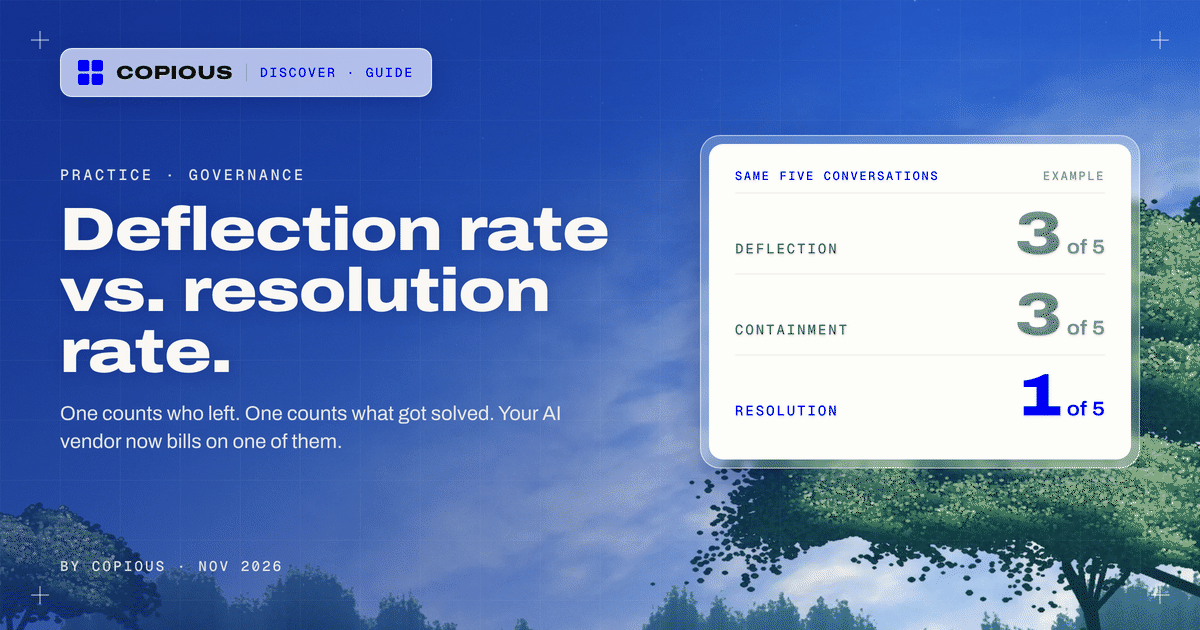
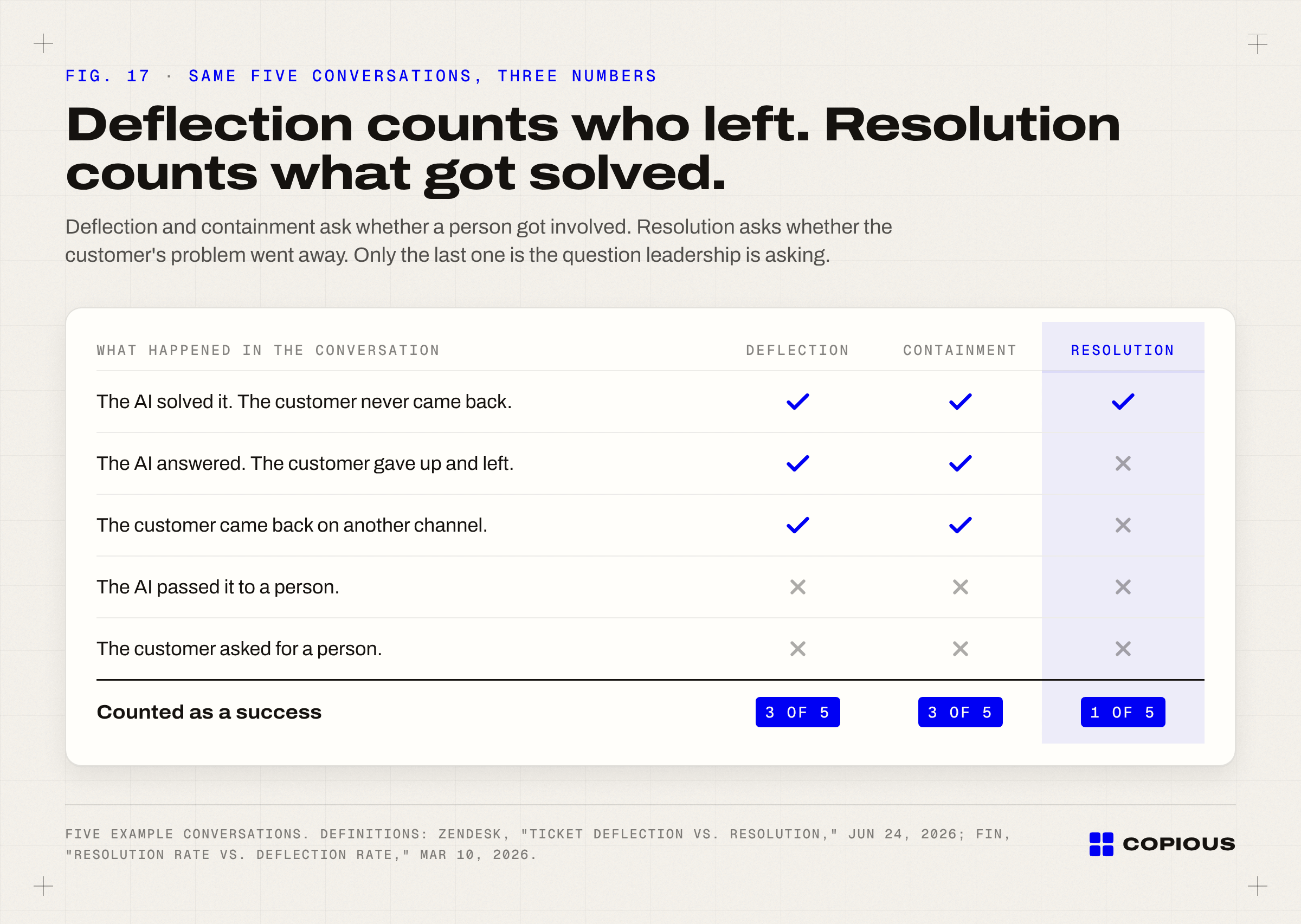
Deflection rate counts conversations that never reached a person. Resolution rate counts conversations where the customer's problem was actually solved. They aren't the same number. The gap between them is customers who gave up, came back another way, or were counted as solved by a model grading its own work. Now that AI vendors bill per resolution, their definition of a resolution is also your invoice.
TL;DR
- Deflection asks whether a person got involved. Resolution asks whether the problem went away.
- Each vendor defines a "resolution" its own way, often checked by a model and inside a time window.
- Read your vendor's definition, then audit 20 "resolved" conversations by hand.
- Report resolution by ticket type to leadership, next to recontacts and handoffs.
What is deflection rate?
Deflection rate is the share of customer contacts that never reach a person on your team. Zendesk describes deflection as routing customers "away from human support queues through options like FAQ links, help center articles, chatbots, or self-service portals." Fin defines it as "the percentage of inbound queries that never reach a human agent."
What deflection doesn't tell you is whether anyone was helped. Zendesk's own guide says deflection "may count unresolved or abandoned interactions, so interpretation should be cautious." A customer who closes the chat window in frustration is deflected.
What is containment?
Containment is the share of AI conversations that ended without a handoff to a person. Fin's definition: it "tracks the proportion of conversations with an AI agent that ended without being handed off to a human." It's narrower than deflection, because it only counts conversations the AI was part of. It still doesn't say whether the problem was solved.
What is resolution rate, and who decides what counts?
Resolution rate is the share of conversations where the AI actually addressed the reason the customer got in touch. Zendesk calls a resolution "the issue is fully completed during the interaction."
The hard part is the word "actually." Someone has to decide each conversation was resolved, and in most AI tools that someone is a model. Fin's guide is candid about it: "most vendors use their own AI to grade their own work."
How do vendors count a resolution?
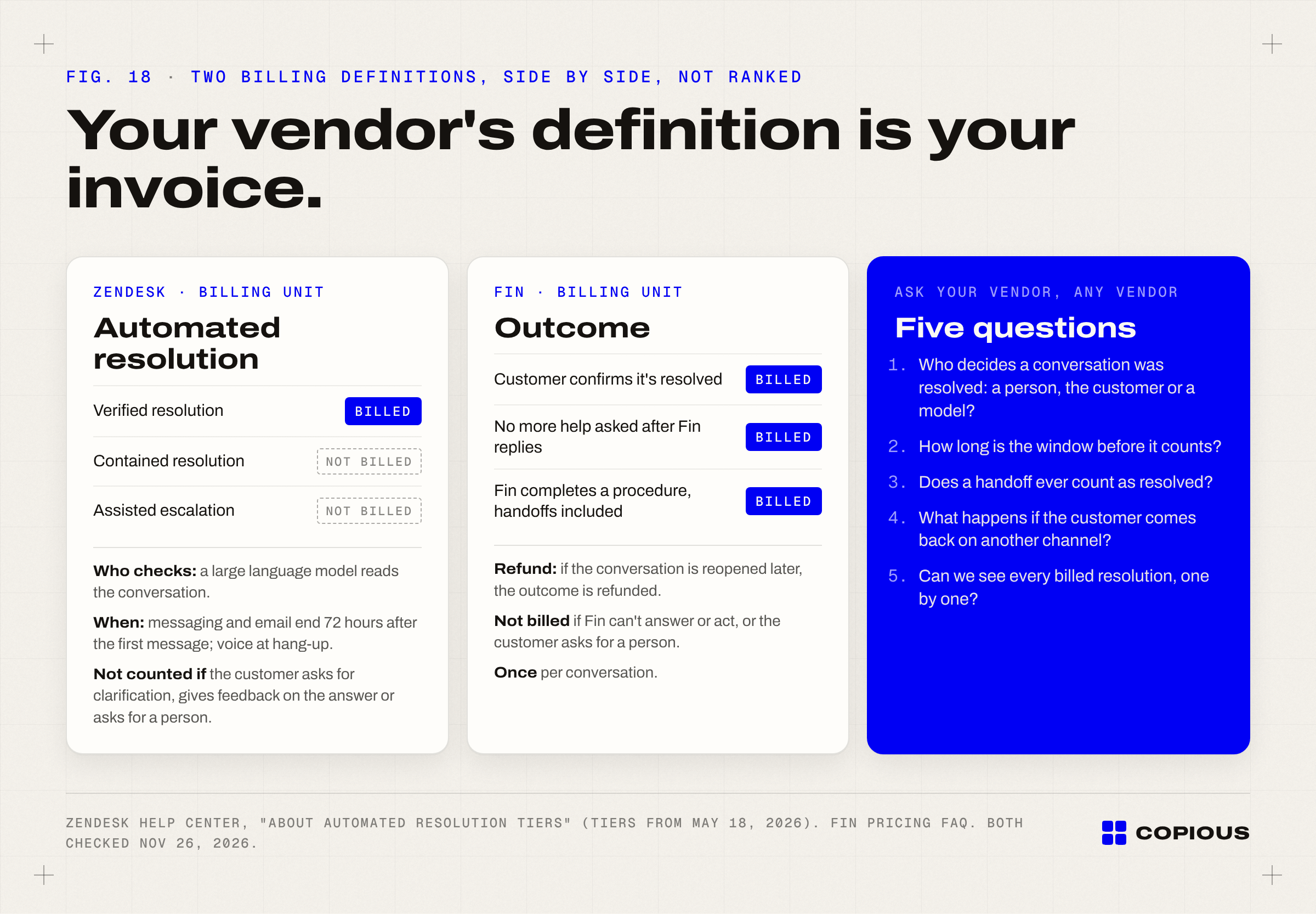
Here are two published definitions, side by side. We're not ranking them. The point is that they differ, and each one is the unit you're billed on.
Zendesk AI agents: the automated resolution. Since May 18, 2026, Zendesk sorts each AI agent conversation into a tier:
- Verified resolution: "The AI agent successfully resolved the interaction." This is the one that's billed.
- Contained resolution: the AI finished the conversation and the customer didn't ask for more help, but the conversation didn't pass verification. Not billed.
- Assisted escalation: the conversation "was still escalated to a human agent to be resolved." Not billed.
Who checks: "a large language model (LLM) that evaluates the text of the conversation." When: for messaging and email, the conversation ends 72 hours after the first message; for voice, at hang-up. A verified resolution also requires that the customer didn't ask for clarification, give feedback on the answer, or ask to speak to a person.
Fin: the outcome. Fin counts an outcome when "a customer confirms their issue is resolved," when "they don't ask for more help after Fin responds," or when "Fin completes a workflow (Procedure), including handoffs." You pay nothing "if Fin can't answer or fails to perform an action, or if at any point the customer asks to speak to a human." It's charged once per conversation, and "if the conversation is later reopened, the outcome is refunded."
Why does this matter more now?
Because the metric moved onto the invoice. Zendesk's AI features use what it calls outcome-based pricing, where "successfully resolved customer issues become the fundamental unit." On Nov 10, 2026, Zendesk opened three new AI features to existing Suite and Support customers free until Jan 31, 2027, with usage "charged from Feb 1, 2027." Fin is priced per outcome.
When the number on your dashboard is the number on your bill, you want to know exactly what it counts.
How can a resolution rate flatter you?
Four ways, each easy to check:
- The customer gave up. They didn't ask for more help because they left. Depending on the definition, that can look the same as satisfied.
- They came back another way. A customer who gets no answer in chat and emails the next morning is two contacts. A window measured on one channel won't see the second.
- They came back after the window. A 72-hour window misses the customer who returns on day four.
- A handoff counted as done. Some definitions count a completed workflow, including a handoff, as an outcome. Read yours.
None of these mean a vendor is doing anything wrong. They mean the number answers a narrower question than the one leadership is asking.
How to audit your AI's resolution rate in 30 minutes
- Pull 20 conversations your AI tool counted as resolved last week. Pick them at random, not the first 20.
- Read each one and mark three things: was the customer's actual question answered? Did the same customer contact you again within seven days, on any channel? Did they ask for a person at any point?
- Count the ones that hold up: answered, no recontact, no request for a person.
- Compare your count with the dashboard's rate for the same week.
- Write down every conversation that didn't hold up, with one line on why. That list is the most useful thing you'll make all week.
Pass line: you can explain every conversation that didn't hold up, and your hand count is within 10 points of the dashboard. If it's further apart, ask your vendor the five questions below before you report the rate to anyone.
The five questions to ask any vendor:
- Who decides a conversation was resolved: a person, the customer or a model?
- How long is the window before it counts?
- Does a handoff ever count as resolved?
- What happens if the customer comes back on another channel?
- Can we see every billed resolution, one by one?
Which number should you report to leadership?
Report resolution rate by ticket type, not one rate for the whole queue. Put two numbers beside it: recontacts within seven days, and handoffs.
Handoffs matter because they predict missed targets. In one queue of 6,952 resolved tickets:
- 1 to 2 handoffs: 16% missed their SLA target, median time 2 hours
- 3 handoffs: 54% missed, median 25 hours
- 4 to 5 handoffs: 72% missed, median 48 hours
- 6 or more: 92% missed, median 102 hours
A ticket type with a high AI resolution rate and a lot of handoffs isn't a success. It's a process to fix first.
And question the flattering number. A 70% deflection rate is either the best queue in the business or a number you should read differently.
Where this doesn't apply
- No AI agent in the queue yet. Then the definitions are a buying question. Ask the five questions before you sign.
- Self-service without conversations. Help center views and searches can't be "resolved" this way. Count recontacts instead.
- Vendor definitions change. Zendesk changed its tiers on May 18, 2026. Check the help center article, not this page, before you rely on a detail.
- Small samples. Twenty conversations show you patterns, not a precise rate. Run the audit monthly and keep the notes.
Frequently asked questions
What is the difference between deflection rate and resolution rate?
Deflection rate is the share of contacts that never reached a person. Resolution rate is the share where the customer's problem was actually solved. A customer who gives up and leaves counts toward deflection but not toward resolution, which is why the two numbers can be far apart in the same queue.
Is deflection rate a bad metric?
It's an incomplete one. Deflection tells you how many contacts didn't need a person, which matters for staffing. It doesn't tell you whether customers were helped, and it can count abandoned conversations. Use it next to resolution rate and recontacts, never alone, and never as the number you report to leadership.
What is a good AI resolution rate?
There isn't an honest universal benchmark, because each vendor defines resolution differently and most grade their own conversations. Compare your AI with itself over time, by ticket type, using the same definition. Then audit a sample by hand. A rate you can explain is better than a high rate you can't.
How does Zendesk count an automated resolution?
Since May 18, 2026, a large language model reads each AI agent conversation and sorts it as a verified resolution, a contained resolution or an assisted escalation. Only verified resolutions are billed. For messaging and email, the conversation ends 72 hours after the first message. Check Zendesk's help center for the current details.
How does Fin count an outcome?
Fin counts an outcome when the customer confirms the issue is resolved, doesn't ask for more help after Fin responds, or when Fin completes a procedure, handoffs included. You pay nothing if Fin can't answer or act, or the customer asks for a person, and a reopened conversation is refunded.
Where Copious fits
Copious helps support and CX leaders decide what AI should handle in their queue and what their people should keep, one ticket type at a time. It reads the structure of your queue, including handoff counts, and files each decision with a date, an owner and the rules applied, so a resolution rate has a ticket type and a reason behind it. We take no money from AI vendors and we don't rank them. Start free at copious.app, no card.
Related: Do ticket handoffs predict SLA misses? · What should AI handle in customer support? · Do customers like AI customer service?
Sources
- Zendesk, Ticket deflection vs. resolution: Metrics that matter, Jun 24, 2026
- Fin, Resolution rate vs. deflection rate, Mar 10, 2026
- Zendesk Help Center, About automated resolution tiers, checked Nov 26, 2026
- Fin, Pricing and FAQ, checked Nov 26, 2026
- Zendesk Help Center, Announcement: Try new AI features free for a limited time, Nov 10, 2026
- Copious, Do ticket handoffs predict SLA misses?, one anonymized queue, 6,952 resolved tickets